

“It is easier to build strong children than to repair broken [adults].”
~ Frederick Douglass
Quick Announcement
I have a survey for currently alienated parents and grandparents who are looking to support my research for my book on reunification. If you are comfortable sharing your experiences and your biggest questions, you will help me ensure this is the best possible roadmap for targeted parents.
This survey has two phases. Phase 1 takes about 7 to 10 minutes. Phase 2 goes deeper — about 20 to 25 minutes. Your answers will directly shape what goes into this book. There are no wrong answers. Please read the legal disclaimers carefully. They are required if you choose to take the survey.
Thank you for your courage and support as I research and put this book together. If you have already taken the survey, please share it with others as well.
Thank you.
Finding Zen

For most of my life, people have told me that I am a great source of calm energy.
I don’t get rattled by most things, I listen to Pink Floyd and other mellow music, and I almost never take things personally. I speak in a slow and deeper cadence so I don’t overwhelm someone with too much energy. This was a kind of superpower back when I worked in retail. I remember de-escalating countless angry customers because I knew they were not actually upset with me; rather, they were upset about an outcome and were afraid that the store would not refund them for any damages to their homes (I worked in a home improvement store).
One of my bosses would constantly tell me, “Andrew, you are my source of Zen. When you are around, I know things will get taken care of, and I always know that I can count on you when I get frustrated.”
As much as this feeds my ego, I will say it is intentional. I cultivated this part of myself because I grew up in a chaotic environment with yelling, drama, backstabbing, countless financial crises, plenty of violence, and constant diminishment of my achievements. I can anticipate what outcomes would upset a person in a short amount of time and plan accordingly to ensure those outcomes do not happen.
Growing up, I had this dream of living a simple life on a homestead where I would do nothing but tend a fruit and vegetable garden, spend time with my family, and work from home. As I got older, I wanted to find “inner peace.”
I was deeply inspired by the idea of being unshakably calm like the Wuxia fighters you would see in Kung Fu movies. This led me to read martial arts books like “The Art of Peace,” by Morihei Ueshiba, which became the backbone of my personal philosophy. In fact, many of the things I teach parents about reunification are modeled on those same principles.
But I have to confess something here, and I will admit it does break the illusion of perfect Zen.
I, too, have my moments when I am dysregulated, frustrated, and angry, to the point of not thinking clearly, saying things I shouldn’t, and even acting immaturely. Even after reading all these books on healing from trauma, personal development, and relationship building, countless hours of meditating and writing about my experiences, and doing intense reflection on my behaviors and what I could have done better—I still lose my cool sometimes.
It is part of being human.
Recently, I was dealing with a gnawing sense of anxiety that was starting to hijack my thinking. I have survived several rounds of layoffs, and the company I work for is still trying to recover from recent market changes. My role as a marketing writer has changed dramatically since the launch of generative AI, so I have to move upstream into marketing strategy before my role is subsumed by senior roles. Sure, writing the traditional way will always be valued, but given the market trends, it is not promising. You see this in how much people prefer to buy from IKEA rather than something handcrafted. Handcrafted costs too much, and IKEA furniture gets the job done affordably. And it is the same view in business marketing when it comes to the use of AI.
Anyways, this anxious feeling was getting overwhelming in a way I wasn’t used to. It was growing stronger, and I knew I needed to act before it hijacked my reasoning and led me to behave in ways that would exacerbate the situation.
I wound up talking to a friend of mine, who had mentored me for a bit in the past, about how to learn better and about using somatic techniques to release stress and name the emotions driving it.
We started by naming the feelings I was having and then ranking them on a scale of 1 -10, 10 being the most intense. At the beginning, I was feeling anxious, scattered, fatigued, pressured, and stuck, all between an 8-10 range.
He then asked me to locate where in the body I was feeling these emotions. Anxiety was a churning feeling, like a washing machine running in my stomach. Scattered in the mind, fatigued and pressured in my shoulders like an exhaustive workout. Stuck was in the sternum.
One by one, he asked me to place my hand on these spots, to close my eyes, focus on the feeling of acceptance, and then to do a physiological sigh. A physiological sigh is when you take a deep breath, then a quick second inhale, before releasing it slowly. I will include a short video tutorial below in case you want to try it.
Note: The version below does a quieter exhale. My mentor taught me to do an audible sigh with the exhales, engaging the vocal cords and chest resonance.
This helped a little bit, but I wasn’t quite feeling better yet. He then asked me to do a modified version of this, in which I would place my hand on the affected area, take a breath, and, as I exhaled, say that I accept the specific feeling I was experiencing and where it was located as plainly and affirmatively as possible. Anytime I said it with an upward inflection (posing the statement as a question), he would ask me to do it again so I would feel the full effect.
So for example, I placed my hand on my stomach, breathed in, and exhaled, saying, “I accept this churning feeling in my stomach.”
Over the course of an hour, I did this for all affected parts of my body, which helped release the stress that was trapped within.
This might seem silly or woo-woo, but the body tenses up when it expects danger. Left unchecked for many years, it leads to extreme consequences like autoimmune diseases, high blood pressure, and potential neurological damage.
Your body braces for impact when it expects to be physically hurt, but it is not quite as able to distinguish the difference between physical and psychological harm. As a result, you might have tension in your body that seems normal because you have always experienced it but is directly tied to a psychological wound you are trying to heal from.
In my case, what we uncovered with my mentor was both unexpected and not surprising. The feelings of being mentally scattered, exhausted and fatigued, carrying a lot of pressure, and churning anxiety were all linked to a single source—and that is one that I have been working through for a long time.
He asked me to see if there was a persona that these emotions were tied to, and I immediately thought of my alienator. I could hear things she would say often, like I wasn't working hard enough, that taking a break is an excuse for being lazy, and that if I did things right the first time, then I wouldn't be in this situation to begin with.
That constant need to perform at a high level was instilled in me at a young age. Good was never enough, I always needed to achieve a high degree of excellence, and much of my identity, even today, is still tied to it. So naturally, when circumstances outside my control, like the market changing and my job being affected creating instability in my current employment, this sudden fear of not being good/smart/prepared enough kicked into full gear and was starting to hijack my nervous system.
It has been 13 years since I left the alienator, and even with all the work I had done to try to heal and move on with my life, there was a part of her still living in my head.
Now, I don’t want to rush and say that is a bad thing. I think the more judgment you place on it, the more control the trauma takes. This is information, and now that I can better see a part of myself that I had overlooked, I can make better-informed decisions for my own well-being and release the things that no longer serve me. The high achiever mentality helped me stay safe from her, but now she is not in the picture and I don’t need to hold on to that part of me anymore.
Excellence has always been a core value to me, and by itself, it is a worthy pursuit. Since it is part of my personal strength, I overlooked it—it is easy to focus on your weaknesses and assume your strengths will be fine to compensate.
However, if excellence is tied to the trauma of needing to be good enough for someone, you won’t be able to sustain a state of flow. Excellence, when tied to curiosity and passion, can take you much farther than fear and submission.
By the end of the somatic exercises, I was able to turn the feelings of scattered, anxious, pressured, fatigued, and stuck into feelings of serenity, mental clarity, and relaxation. I was more focused and able to make a few plans for myself to better juggle the tasks I was trying to handle, so I could better protect myself in the event of a layoff. My situation didn’t change, he didn’t tell me how to better handle my problems, and I wasn’t going to get any handouts. But I wasn’t held back by the negative emotion, and that makes all the difference when you need to be creative and focused.
It is really hard to be creative and solve complex problems when you are panicking on the inside.
The point I want to make here is that all of us carry this kind of stress from both our day-to-day lives and the alienation. Knowing how to recognize it and how to address it is the most important step in healing after alienation so that you do not spiral into a chaotic mess.
I say this always,
“Alienation doesn’t end at reunification. It ends when you and your child have healed together and have created something new.”
Your alienated child may not be able to see the sharp rocks on the coastline, but you can be their lighthouse and guide them safely through the storm. The physiological sigh is just one technique you can use in your toolbox.
Now you might be thinking, Andrew, this is great and all, but I am not a therapist or psychology expert. What would my child need to really heal from alienation?
Well, I happen to have some very good news…fasten your seatbelts, because this will rock your socks off.
The Healing Qualia Treatment Protocol

“The term qualia originates in philosophy and refers to the subjective quality of conscious experience, the “what it is like” dimension of perception, emotion, memory, and meaning that cannot be fully captured through external observation or biological measurement alone. It describes the inner reality of experience that remains uniquely personal even when external circumstances appear identical. Two individuals may witness the same event, hear the same words, or undergo the same developmental disruption. Yet, the internal meaning, emotional texture, and embodied response will differ in ways that cannot be standardised.
…The term Healing Qualia was selected as the organising framework because adult survivors of child psychological abuse in the context of parental alienation (CPA-PA), the broader clinical umbrella used throughout this volume, often present not only with attachment disruption and trauma-related symptoms, but with profound injury to the internal systems through which experience, meaning, and reality are organised.
~ Dr. Alyse Price-Tobler, Healing Qualia
One of my close friends and fellow former alienated child, Dr. Alyse Price-Tobler, has put together three volumes based on her research on adult survivors of severe parental alienation. The Healing Qualia Treatment Protocol is in her recently released volume 3.
Note: For full transparency, I was also invited to write a short essay about the mind of an alienated child from my perspective, which was included in the book, and several of my photos are inside the book and on the cover. I do not receive any royalties from book sales, aside from any Amazon affiliate commission through my affiliate account.
While Alyse is a close friend, I am sharing her work because it aligns with what I teach parents, and it validates many of the observations I have seen in the alienation community in the last 12+ years.I have been privileged to read her work prior to its release, and now that the books are available to the public and with Alyse’s permission, I am happy to share some of the groundbreaking insights she has.
But before we go further…Healing Qualia is a treatment protocol for clinicians working with adult survivors of child psychological abuse in the context of parental alienation. It examines psychological adaptations that began in childhood, but the patient receiving the treatment is an adult.
It is not a treatment model for presently alienated minor children, and it should not be promoted as one. Working clinically with a child requires separate developmental assessment, safeguarding, consent, caregiver considerations, and legal considerations that this protocol does not set out to cover.
Alyse has told me that some of the principles may potentially be adapted for older adolescents, possibly from around 16 years of age, but only by an appropriately qualified clinician who understands trauma, parental alienation, developmental needs, and safeguarding. That is a specialist clinical adaptation, not the protocol’s intended use.
So when I say “your adult son or daughter” through the rest of this letter, I mean it literally.
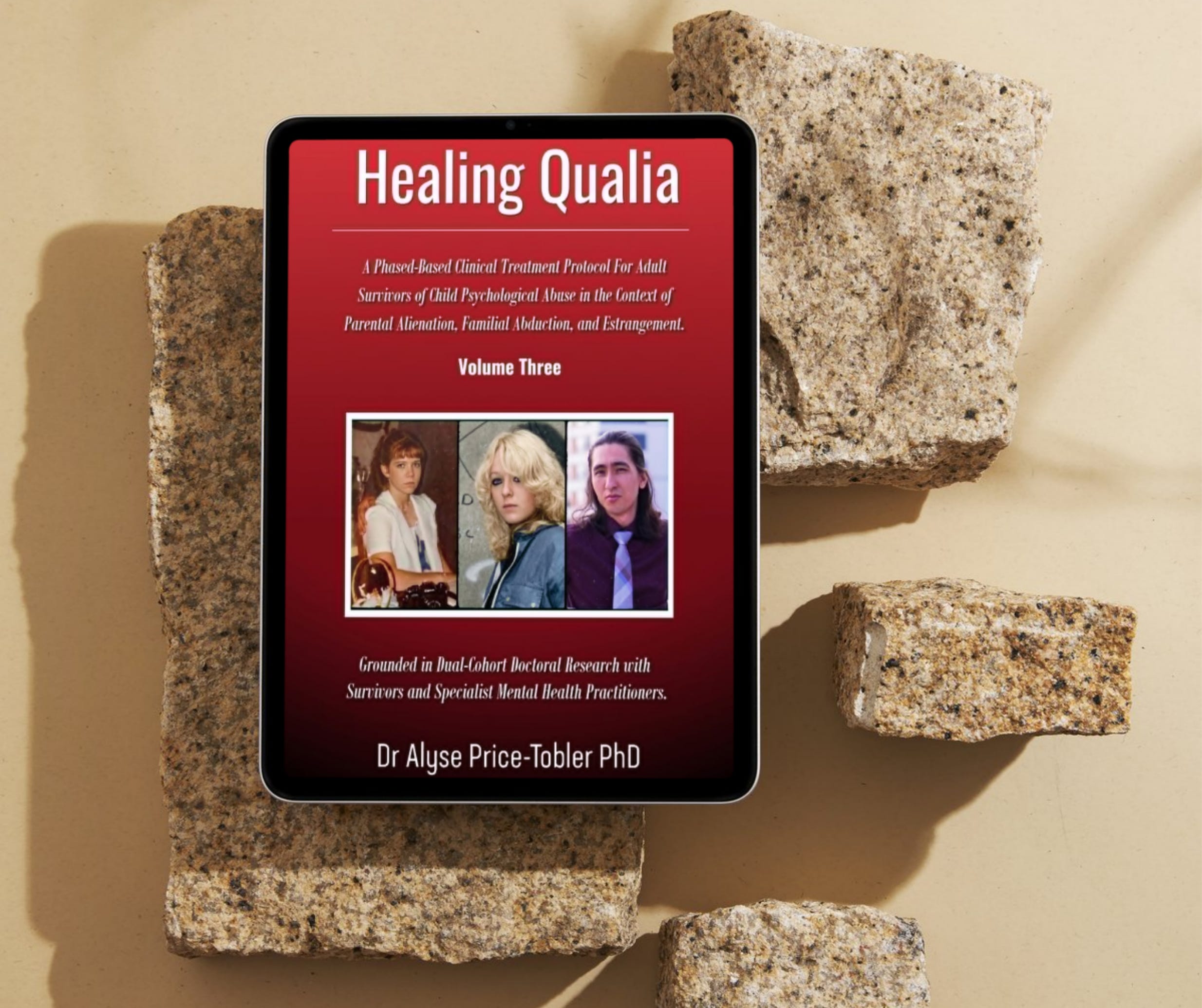
While the book is built around the clinical work, I found throughout my read that there are nuggets of gold that parents can take home and apply to their situations, so that we are creating an environment of safety and warmth around our children instead of pressure.
This book is 1,051 pages, so it is a tome to get through but never fear, I am here to share with you the best parts.
You can get Healing Qualia here. The treatment protocol itself is delivered by a clinician, but Alyse was clear with me that the book is written for a much wider audience than that. Teachers, lawyers, Independent Children’s Lawyers, allied professionals, and parents can all use it. So read it yourself if you want to. Then consider buying a copy for your local library and getting it in front of the clinicians and professionals in your area.
What does healing look like for the adult survivors of child psychological abuse?
Most of the current literature fixates on alienation occurring as a result of divorce. However, this overlooks a huge demographic of children who endured alienation as a result of abduction, prolonged alienation years after a divorce, alienation occurring in homes with in-tact marriages, and estrangement—where a targeted parent was given very little information after their child was born, or was never told about the birth at all, and was then denigrated every time that child asked about them.
Adult survivors of child psychological abuse take the traits that were instilled in them and adopt them as part of their adult identity without realizing they are reacting as a result of trauma wounds.
There seems to be this notion going around that the adult survivor of alienation is pathological—meaning that their behavioral traits are the product of mental illness and therefore must be treated as if it were a syndrome or disorder.
However, blanketed statements like that do far more harm than good. The implication is that alienated children, even the ones who are now grown and have separated from the alienator, are too unstable to think for themselves. Arguments like that suggest that myself, the many formerly alienated children who speak out publicly, and your children are forever incapable of deciding what is best for themselves.
Healing Qualia shows the flaws in this thinking, detailing that your son or daughter is not pathological; they are operating through a lens much closer to PTSD.
Just as a soldier returning from war develops a series of extreme behaviors that protect them from a hostile environment, so too did your child develop a series of extreme behaviors tied to family attachment, and they carry those behaviors into adulthood. A veteran knows the war happened and can point to it, whereas your child's training reached the machinery they use to decide what is true at all. Dr. Alyse Price-Tobler describes this as a collapse in what psychologists call source monitoring, where the child loses track of where a belief originally came from, so an installed narrative from an alienator feels like it was something they came up with. They defend it because it feels like theirs, and any attempt to pull it apart feels like being asked to doubt their own mind.
Why? It is because your child connects the approval of the alienator with access to key survival resources like food, shelter, safety, and a sense of belonging in the world. When keeping that parent close requires rejecting you, the child does so because it is the safest available move. Now this choice is not entirely conscious—your child is not saying to themselves, “I want to hurt my mom/dad/grandparent.”
There are two parts of your child here. One is the child that loves you. That part is pushed out of the way by the second part: the part of the child that has to protect him/herself. That part of the child will do whatever he/she has to do, regardless of right or wrong, to ensure they are safe. If the child’s brain is like a car, the part of the child that loves you and wants to connect with you is locked in the trunk, and the part that manages survival takes the wheel and drives.
The treatment protocol details how clinicians can work with the part of the adult survivor that is still entrenched in the alienation.
It does not guide the survivor back to some hidden “true self” waiting underneath the alienation, and it does not steer them toward reunion with a targeted parent. Neither of those is the goal, and the protocol says so plainly. What the work aims at is a person who can think with their own mind and choose their own life, whatever they end up choosing.
The six phases are sequenced, and they do not run on a timeline. A survivor moves forward when they have the capacity to carry the next piece of work, and that judgment belongs to the clinician sitting in the room with them. Two survivors can start on the same day and be years apart in where they end up, even when both of them are doing it correctly.
Moving backward is also part of the design. Dr. Alyse Price-Tobler calls a return to an earlier phase ethical recontainment, and it means the therapy has unlocked a part of the survivor they have not fully processed yet, so the clinician can walk them back until they feel grounded again. This is different than a relapse. The whole structure is built for sustainability rather than speed, and a survivor who moves slowly is a survivor who is able to heal. In other words, you move slow to move fast.
Dr. Price-Tobler states that therapeutic success “is not defined by reconciliation, forgiveness, symptom elimination, or family contact.” A survivor is also not failing this protocol if they never fully understand/recognize the depth of the abuse.
Now, I know how that sounds disheartening when you are the parent who has been waiting years for reunification. That said, I want to caution you against promises of faster methods because a treatment protocol aimed at forcing reunification and telling the survivor they were alienated is simply applying alienation tactics in reverse, which exacerbates the damage.
Each phase carries entry conditions and decision points instead of a script, which is why Dr. Price-Tobler calls the book a decision guide. The clinician is choosing among options at every turn based on what the survivor can handle, so the same protocol can be tailored to the adult in front of them.
A crisis structure runs underneath all six phases, and it stays live in every one of them. It is not a switch that flips on for one dangerous moment and off again afterward. Risk in this population can arise in the first session, in the middle of grief work, at the point of contact, or years later at a funeral. So the tiered risk levels, the escalation ladders, and the written crisis plan travel with the survivor through the entire protocol. We will come back to that, because it governs a great deal of what you can and cannot do as a parent.
Every phase also carries a companion note written in plain language for the survivor themselves, under the heading “Explained for Adult Survivors.” Those notes were written to be read alongside a therapist rather than alone, which matters for what I am going to ask you to do with this book.
Now that you understand the basis for the six phases, let’s dive into them.
Phase 1: Safety, Orientation, and Epistemic Stabilization
Before an adult survivor can look at anything that happened to them, three kinds of safety have to be in place, and the third one is the reason this phase exists.
Physical safety is the one you would expect. Relational safety means the room is a place where they will not be punished for anything they say in it. Epistemic safety means safety inside their own mind, and it is the capacity to trust their own account of their own life before anybody asks them to defend it.
The opening work is built on attunement rather than on asking the survivor to justify their history. Your adult son or daughter is not asked to lay out a timeline, prove that harm occurred, or demonstrate insight into their own situation.
When a survivor asks the clinician to tell them what really happened, and they do ask, the clinician declines to confirm it and declines to dispute it. The clinician works instead with what the need to prove is doing to the survivor. At face value it seems like the clinician is not doing anything. However, your son or daughter grew up in a house where an adult supplied reality on demand, so a therapist who hands them a competing account is one more adult telling them what to think, and the survivor’s own judgment stays parked either way.
The move that opens the door is one Dr. Price-Tobler calls naming the behavior before naming the relationship. The survivor is invited to look at a single behavior and describe it accurately, carrying no obligation to make a judgment about the person who did it. A parent may be loved and still be coercive, and both of those can be true in the same sentence. Your adult son or daughter can name one thing, leave every other belief standing, and walk out still loving the parent who harmed them.
Phase 1 also holds the body work. The protocol treats physiological regulation as the floor of the entire structure, restoring physical safety before any cognitive or narrative processing is attempted, which puts breathing, grounding, and nervous system work at the beginning rather than filed away as a soft add-on. The somatic exercise I walked through earlier in this letter sits at exactly this level, and it is why an hour of naming sensations gave me more clarity than weeks of thinking intensely about my situation had.
The crisis architecture is established here as well. Tiered risk levels, escalation ladders for the survivor and for the practitioner, and a written crisis plan are all built in Phase 1 and they stay active through all six phases, because there is no point in this work where a survivor cannot be knocked off their feet.
From where you are standing, Phase 1 will look like nothing is happening. Months can pass in which your adult son or daughter has not said one word about you, the alienation, or the years you lost. However, Phase 1 is the foundation, and the stability of all future phases depends on it.
Phase 2: Meaning Reconstruction and Identity Repair
Phase 2 is where your adult son or daughter begins building an account of their own life that belongs to them.
Most parents picture recognition as a single moment where their child connects dots like you would see in a crime thriller where the detective suddenly puts together the mystery. The fog lifts, they see what was done, and they come home.
Dr. Price-Tobler describes the process as far slower, treating recognition as a developmental process that occurs in small moments across months, and sometimes years. A survivor can spend a year trying to understand one thing about their childhood before they are ready to look at the next part of themselves.
The core work of this phase is meaning, and it is observational rather than behavioral. Your adult son or daughter is learning to notice which thoughts and feelings originated with them and which were installed during the alienation. Noticing is the whole assignment. They learn to see the difference long before they do anything about it. The protocol deliberately keeps contact decisions, boundary decisions, and anything involving you out of this phase entirely.
Clinicians do not debate about whether a belief is accurate, and make no attempts to talk the survivor out of anything. The working questions are where a belief came from and what it was doing for them, which keeps the survivor’s own judgment in the driver’s seat while the belief gets examined.
This is also where Dr. Price-Tobler introduces the concept I found most useful in the entire book. She calls it the evoked companion, and it is the internalized presence a survivor carries with them long after they have left that environment.
It is broader than the voice of the alienating parent, though that is often the loudest part of it. It can be internalized criticism, absorbed fear, warnings, loyalty rules, and relational messages from the wider family system—the people whose approval your son or daughter had to keep managing. It lives in their mind as self-criticism, polices their loyalty, and tells them what they are allowed to want. The three questions the clinician works with are whose voice this is, what it once helped the survivor survive, and what it is costing them now.
I described one of mine earlier in this letter. Thirteen years after leaving my alienator, her voice was still telling me that rest is laziness and that good is never good enough, and I had built my entire professional and personal identity on top of it.
Dr. Price-Tobler draws a hard line around this phase, writing that it must not be treated as a pathway to reconciliation, forgiveness, or relational repair. The moment recognition gets pointed at forcing a reunion, it becomes one more adult steering the survivor toward a conclusion they did not reach themselves.
Phase 2 is also some of the most fragile ground in the protocol. When a survivor's account of their own childhood comes apart, what goes with it is their sense of who they have been.
Which brings me to the part that will be hardest for you to hear. If your adult son or daughter ever begins to question the story they were given, you are looking at one of the most vulnerable moments of their life, and that is still not the moment you get them back.
Patience as a parent is paramount.
Phase 3: Mourning, Loss Integration, and Developmental Grief Repair
Once an adult survivor can see what happened to them, they have to grieve what it cost them.
This is more than just the parent who was pushed out of their life. There are grandparents who are also pushed out. Some relatives pass on before reunification. They meet siblings and cousins they were never told about or were cut off from. Birthdays, graduations, family vacations, special events, and ordinary Tuesdays that went by without you in the picture. And the worst part is they didn’t realize it was all slipping away.
Dr. Price-Tobler frames that loss two ways at once. It is an attachment injury, which is the part most people can see. It is also a violation of developmental rights, which is the part that gets missed. Your child had a right to a relationship with you, a right to their own family history, and a right to an accurate account of their own childhood. Each of those was removed without their knowledge and without their consent.
What makes the grief so difficult to process is that nothing ever ended. Pauline Boss named this ambiguous loss, where the person you are mourning remains alive and is technically reachable. Nobody held a funeral for your relationship, and as a result, grief with no confirmed ending has nowhere to go, so it sits in the body for decades and gets mistaken for depression.
Your adult son or daughter is carrying two streams of it at the same time. They are grieving you, and they are also grieving the alienating parent, who may be alive and potentially still involved.
The clinician’s stance through all of it is what Dr. Price-Tobler calls attuned validation without forensic alignment. The grief is fully supported while the question of who was right stays off the table. The moment a therapist begins assigning fault, the loss turns back into a case that has to be argued, and the survivor goes right back to defending a position instead of feeling what they lost. Feeling is the point. A person cannot heal wounds they do not see.
Forgiveness and reunion are not requirements of this phase, and neither is a resolution. Your adult son or daughter can mourn everything that was taken without absolving anybody and without any relationship being restored. Grief work is its own destination and is not the precursor to reunification.
Your adult son or daughter may need to grieve you even after they are back in your life because the parent they lost was you all those years ago, and that version of you does not exist anymore. Neither does that version of them.
Your own grief over those same years is real, and it deserves care and attention. However, it is not your child’s burden to carry.
Phase 4: Trauma Integration Readiness Architecture
Most people carry an assumption that healing from something terrible requires going back into it and telling the whole story out loud. Dr. Price-Tobler treats that assumption as something to be tested case by case.
Seven decision trees, a list of contraindications, and a set of exit criteria all sit in this phase, and together they answer one question. Is this survivor resourced enough that opening the past will help them rather than harm them?
Dr. Price-Tobler goes further, writing that “many adult survivors never need to revisit specific memories.” Some survivors reach a stable, examined, self-directed life without ever reconstructing the worst of what happened, and the protocol counts that as a completed outcome rather than an unfinished one.
When processing does go ahead, the method gets chosen against what the survivor can handle at that moment. Somatic work, narrative work, psychodynamic work, and EMDR are each placed by readiness, and a survivor who is steady enough for one may be nowhere near ready for another.
Dr. Price-Tobler also bars the clinician from what she calls over-functioning, which means driving the pace, prescribing what the survivor ought to do about their family, or carrying the work on the survivor’s behalf. The survivor sets the speed even when the clinician can see further down the road than they can.
Two things follow from this phase, and both are for you.
Healing does not require reliving. If your adult son or daughter ever tells you that they have no interest in digging through what happened, they may be describing a clinically sound position rather than avoidance, and pushing them toward a therapist who will excavate it can undo years of progress.
The second one is you may never be told the story of their alienation. Many targeted parents are waiting for a detailed account, an acknowledgment, or a moment where the record finally gets set straight in their child’s own words. A survivor can heal completely and never tell you what happened, because the account was never the point of their recovery.
Frankly, knowing the details of their trauma will not help you as a parent either. What is most important is that you accept that they will share what they feel comfortable sharing, and that you can build toward something new with them as they are healing.
Phase 5: Differentiation, Boundary Formation, and Contact Decisions
Phase 5 is where differentiation, boundaries, and contact all get worked directly, and Dr. Price-Tobler writes that contact “is never treated as a treatment goal.”
The reason is that if you optimize for reunification as the end goal, you get what I think of as the cobra effect, where a well-intentioned goal produces drastic unintended consequences. It is also why you hear so many formerly alienated children publicly talk about how reunification therapy made things worse.
What the phase builds is your adult son or daughter’s capacity to make that decision on their own terms. The working order is behavior first, relationship second. They learn to evaluate how a person actually behaves, and then decide what relationship they want. The method gets applied to everyone in the family, including the alienator and you.
The decision belongs to them alone. Dr. Price-Tobler bars the clinician from it in plain terms, writing that the clinician “does not guide relational outcomes, recommend contact strategies, or evaluate moral correctness,” and she treats continued contact, reduced contact, modified contact, and no contact as context-dependent decisions rather than prescribed outcomes.
The book handles the reunion itself with more care than most parents expect. Dr. Price-Tobler draws on research into eye contact showing that sustained eye contact with a person the nervous system has filed as threatening produces a measurable stress response, which means their body may react to your face before their mind has any say in it. She also names the shock of seeing the person as they are now. They will remember the version of you from when the alienation began, and the person you are today has aged, changed, and lived a whole life they were not there for.
They are also walking into an existing family system with its own routines, in-jokes, holidays, and new people who came after they left. Dr. Price-Tobler states directly that even a reunion that goes beautifully can be destabilizing, which is worth remembering if your first meeting goes well and then everything goes quiet for four months.
What the book asks of the targeted parent during Phase 5 is restraint. Do not lead with your grief. Let them look away when the eye contact is too much. Do not put your adult son or daughter in the position of managing your feelings about the reunion while they are still working out how they will handle it themselves.
Now I need to be candid here, because at face value this next part will sound alarming, but it needs to be read with context.
The outcome they choose may not include you. Dr. Price-Tobler legitimizes that decision explicitly, writing that some survivors decide not to reconnect because it does not feel safe, and that healing is not measured by reunion. She applies it to the targeted parent, not only to the alienator. A survivor can complete every phase of this protocol and still decide that contact with the family system costs them more than they are willing to pay.
I have seen this first hand. That is why I spend so much time teaching parents to create a container of safety, warmth, and positivity. Doing so does more than words can say.
Everyone’s situation is different. Some targeted parents have non-negotiables that rub their alienated children wrongly, ultimately leading to them not fully reuniting even if the alienator is out of the picture.
As a targeted parent, you will have to decide which is more important.
Phase 6: Integration, Continuity, and Long-Term Adaptation
Phase 6 is where the therapeutic work stops being about the alienation and starts being about the life your adult son or daughter is building.
Dr. Price-Tobler designs this phase around continuity. A survivor who finished their treatment and comes back has not relapsed, and the protocol says so explicitly.
The reason is that the wound reemerges at every stage of life whether they are getting married, holding their first child, watching their own kid turn the age they were when it started, deciding whether to attend their alienator’s funeral, and many more difficult decisions and emotionally charged moments.
A survivor who has completed this work still has hard days. The difference lies in being able to decide that the old habits and knee-jerk reactions no longer decide on their behalf, and the person gets to choose what happens next.
Dr. Price-Tobler says, “Healing is not the absence of pain, but the presence of choice.”
The person who comes through Phase 6 is not the child you lost. There is no original, untouched version of them waiting underneath the alienation to be recovered—that person was never given the room to develop and grow in the first place. What’s left at the end is someone who did the work themselves and built an identity of their own choosing. Whatever relationship you have with that person is going to be built from scratch, between the two people you both are now.
We cannot repair the past, but we can ensure it does not change who we can be right now. That is how you build a future together.
Put This Book in Your Therapist’s Hands
Research on alienation continues to grow, and countless experts and formerly alienated children are stepping forward to push for better solutions for survivors.
The majority of my readers are targeted parents, so a book this clinical may not seem helpful at first, but I wanted to spotlight this because change is coming. As parents, our job is to create an environment of safety around our children. A parent cannot engineer a reunion, but they can provide the safety their child needs.
That division of labor is deliberate, and it protects your child. I am not a psychologist, and most of the parents I speak to aren’t either. But we can understand the high level frameworks that are present in Healing Qualia so that we know why we are approaching alienation this way.
Restraint is going to be the one thing that matters most for the targeted parent. Dr. Price-Tobler documents that telling a survivor they were brainwashed strengthens the belief, and she rejects deprogramming outright. The way through is gradual, and it requires at least one relationship with no coercion anywhere in it. Which means the single most tempting move available to you—sitting your adult son or daughter down with the documents and the timeline and the proof—is the exact move the protocol treats as dangerous.
There is one exception. If your adult son or daughter independently asks for the proof or the documentation—on their own initiative, with support around them and the readiness to receive it—that is a different situation entirely. The material itself is not the problem. Using it to force recognition or to secure a reunion is the problem. Wait to be asked, and then follow their lead on how much and how fast.
Beyond that, there is one thing you can put into the process without touching it.
Buy the book, and get it in front of the clinicians. You are welcome to read it yourself for the literacy, because understanding what your adult son or daughter is going through will change how you respond to them. Hand it to your own therapist, who is currently helping you process the wounds of alienation. And if your adult son or daughter is in therapy and you have any line of communication at all, get the title in front of that clinician.
Chances are that clinician is underequipped for the mountainous task of navigating alienation. Dr. Price-Tobler’s own research asked ten practitioners treating these survivors what they use, and thirty-seven different treatment approaches came back with almost no overlap between them. Ten therapists, thirty-seven methods, no shared framework. Those clinicians were reaching for whatever they had, because nothing built for this population has existed until now.
She is equally direct about the size of the gap on the practitioner side, listing ten domains of competence and seventy-two training topics that this work requires, and naming ongoing supervision as a structural requirement rather than a nice idea. Most therapists have never treated an adult survivor of alienation. A good number of them already suspect it.
Two things before you order it. The book runs past a thousand pages and it was written for professionals, so treat it as a reference work rather than a weekend read. And the plain-language companion notes for survivors that sit inside each phase were written to be read alongside a therapist rather than alone, which is why those notes in particular belong in a clinician's hands rather than being handed to your son or daughter to work through by themselves.
One last thing before you order it, because your therapist will ask, and I would rather you hear it accurately from me.
This protocol did not come out of a theory somebody sketched at a desk. It came out of Dr. Price-Tobler’s international twin-study PhD research with eleven adult survivors and ten specialist mental health practitioners. The clinical architecture built on top of that research has been developed, applied, and refined across more than ten years of data collection, clinical practice, observation, and work with adult survivors internationally.
It has also been through other people’s hands. Clinicians she trained and supervised have used elements of the framework with real patients and reported back on what worked and where the safeguards had to be tightened and that feedback went back into the protocol. Fifteen specialist clinicians and adult survivors read the manuscript while it was being developed, and their notes shaped its clinical language, its accessibility, and its survivor-protective focus. Dr. Price-Tobler also applied these principles inside her own family relationships. What she watched shift there, in recognition and emotional safety and how people moved toward one another, fed back into the work as well.
Now, none of that is the same thing as an independent controlled trial. Healing Qualia has not been through one yet, Dr. Price-Tobler does not claim it guarantees a particular outcome for any given survivor, and she welcomes independent evaluation of it.
It is empirically grounded, evidence-informed, clinically developed, lived-experience informed, and practice-refined—with the formal outcome research still ahead of it, and now a substantial clinical foundation to build that research on.
Even so, I have not seen a more complete map in this field, and I truly believe it will set a new precedent for how we treat survivors.
Until next time,
Andrew Folkler
Are You a Writer on Substack?
If you write about alienation or estrangement, let me know! I would be happy to exchange recommendations to better support our readers.
If you are a general reader who writes about other topics on Substack, please consider recommending Shortening the Red Thread so that other parents can find this newsletter and get the support they need to reunite.
As always, I deeply appreciate your support, and I am grateful for your feedback as I develop these articles.