

“I am half inclined to think we are all ghosts... It is not only what we have inherited from our father and mother that 'walks' in us. It is all sorts of dead ideas, and lifeless old beliefs...”
~ Henrik Ibsen, Ghosts (1881)
Quick Announcement
I have a survey for currently alienated parents and grandparents who are looking to support my research for my book on reunification. If you are comfortable sharing your experiences and your biggest questions, you will help me ensure this is the best possible roadmap for targeted parents.
This survey has two phases. Phase 1 takes about 7 to 10 minutes. Phase 2 goes deeper — about 20 to 25 minutes. Your answers will directly shape what goes into this book. There are no wrong answers. Please read the legal disclaimers carefully. They are required if you choose to take the survey.
Thank you for your courage and support as I research and put this book together. If you have already taken the survey, please share it with others as well.
Thank you.

Sins of the Father, Sins of the Son
When I look at the story of my own life, I see the consequences of my parents’ choices directly shaping what options were available for me as well as the difficulties I had to endure to survive.
Each moment is like a domino, catalyzing a series of predicaments that would ultimately define my journey through alienation.
Lately, I have been rereading Mark Wolynn’s book “It Didn’t Start With You: How Inherited Family Trauma Shapes Who We Are and How to End the Cycle.”
I read it a few years ago, and while rereading it for this article, I realized something a bit too similar to call a coincidence. My father lost his father when he was 10, and my brother lost his father at the same age.
Throughout my life, my father would always tell me that he wants me to learn from his mistakes so that I don’t make them myself. As a new parent myself, I think it is safe to say that all well-meaning parents hope that their children are able to live lives that surpass their own. It is one of the noblest goals we hold as human beings.
My father would tell me stories of his greatest successes once in a while but he usually focused on stories of his greatest failures and loss.
When he was young, his parents had divorced, and shortly after, when he was around 10, his father passed away. His stepfather treated him as a burden, which led him to move out after high school, taking small jobs to get by while bouncing between different communities.
By his 30s, he realized he wanted to have a family and changed up his life to make it possible, going back to university to get a degree, and getting married to my mother. Not long after, I was born.
Family life was not as easy as expected. My mother was an immigrant from Malaysia and my father was early in his career. There was not much help available from either side of the family so my mother relied on friends to help take care of me and eventually my brother, while my father aggressively tried to grow in his career to provide for the family.
The pressure alone was enough to break up their marriage, leading to their divorce in 2001. Shortly after, he remarried to the woman who would become my alienator.
Now in retrospect, my father never would have married her had he known what lay ahead. As smart a man as he is, clairvoyance was never his forte. In his mind, he wanted to delegate the responsibility of raising the children to a competent woman who loved him and their family above everything else. Seeing that my alienator was an early childhood education specialist, he thought, who better to take on the role?
And in many ways the alienator took on the role of what he had hoped for, she just took it to the extreme. By the time he saw her behavior for what it really was, it was 12 years too late.
Like most kids, I always looked up to my parents, but due to the alienation, that part of me was cut short regarding my mother. My father was well read across a number of disciplines, allowing me to engage my curiosity about the world through asking him all kinds of questions.
Now that I am older, I see how deficits in his upbringing have led to repeated mistakes made on his part to fill a gap or heal a wound that he has not been able to consciously manage. It is hard to express without going into details, but what I can say is that those decisions are what brought me here.
My youngest brother in Singapore has been alienated from my father since he was 10. It has been about 13 years, and he is completely estranged, believing lies about his character that make the discussion of reunification too difficult to bring up.
In a way, my youngest brother is reliving the trauma wounds of my father unknowingly. My father lost his father early on due to physical death. My brother lost his father to a psychological death and today my brother works aggressively to survive a challenging economy while balancing the many other duties of modern life, just as my father did in his 20s.
This doesn’t mean their lives are exactly the same beat for beat. My brother will also live his life based on the dreams, values, and aspirations that he holds for himself.
But what it does mean is that while financial debt and social caste no longer get passed on from a parent to a child (thanks to modern ethics and legalities), we still carry traces of their wounds and the direct consequences of their choices.
Trauma Can Be Passed Down Through Our Biology and Our Relationships
“Unresolved traumas from our family history spill into successive generations, blending into our emotions, reactions, and choices in ways we never think to question. We assume these experiences originate with us. With their true source out of sight, we’re often unable to differentiate what is ours from what is not.”
Wolynn argues that trauma travels two ways: through the body and through our relationships.
We know from biology that our genetic makeup is approximately half of both parents. Not only does that include phenotypical attributes like our appearance, natural abilities and proclivities, and how our internal bodily systems function, but it also impacts how we respond to stress, including how quickly our bodies go on alert and how long it takes us to calm back down.
What researchers have found over the last few decades is that our genes are also shaped by what our parents lived through. Experiences like trauma and chronic stress can change which genes get switched on or off, a process called epigenetics, and some of those changes may reach the next generation.
The connection goes back further than most of us realize. A woman is born with all the eggs she will ever carry, which means the egg that became you first formed while your mother was still a fetus inside your grandmother. For a short time, three generations shared the same body and the same biological environment.
Researchers at Emory University did a study where they trained male mice over three days to associate the smell of acetophenone, a scent similar to cherry blossoms, with a mild shock. Those mice then fathered pups, and both the pups and their own offspring reacted to that scent even though they had never smelled it before. They did not react to other scents, and they were not more anxious in general. Pups conceived through IVF or raised by unrelated mothers showed the same sensitivity, which points to the father’s sperm as the carrier.1
In people, the evidence is strongest between a parent and their child, especially during pregnancy. When researchers followed mothers who were pregnant and near the World Trade Center on 9/11, the mothers who went on to develop PTSD had lower levels of the stress hormone cortisol, and so did their babies at one year old.2 Scientists are still debating how much of this passes through our genes beyond the first generation.
The second way trauma travels is through our relationships. Parents tend to pass on the parenting they received, often without realizing it, because the way we were raised is the only model most of us have when we start raising children of our own.
Wolynn, drawing on the work of family therapist Bert Hellinger, also describes how children can take on a parent’s feelings, fears, and burdens as if they were their own. Hellinger called this entanglement and saw it as a form of loyalty, a child’s way of staying close to a parent by carrying what the parent carries.
This is one of the foundational components in alienation. Alienated children carry the alienator’s fear as their own. Whatever the alienating parent fears about the targeted parent becomes what the child fears, and the child experiences it as their own judgment.
Now, Wolynn also points out that what we inherit includes strength. The traumas passed down to us can create a legacy of resilience that lasts for generations, just as they can create a legacy of distress.
If we take a step back, our response to trauma is a survival mechanism to ensure we take some kind of immediate self-preserving action so we do not die. Granted, the stakes are quite different from pre-civilized times, but our deepest fears are rooted in isolation from other people, mortal wounds and severe illnesses, and loss of autonomy. These fears carry over in the modern world.
Depending on a range of factors like the intensity and frequency of exposure to harsh difficulties, the individual may process their trauma at varying levels. Psychiatrist Dan Siegel describes what he calls the window of tolerance, the range of stress a person can handle while still thinking clearly, feeling their emotions, and staying connected to the people around them.3 Above the window, the body goes into fight or flight, and we become anxious, reactive, or angry. Below it, the body shuts down, and we become numb, withdrawn, or checked out. Trauma narrows that window, so a person who carries it has less room before small things push them out of it into a survival state.
Want to learn more about the different brain states and how to navigate the survival state? Read my article: Seeing through the Eyes of the Alienated Child
Children learn to stay inside their window from the adults around them. A calm parent helps soothe a child’s nervous system, a process psychologists call co-regulation, and over time the child learns to do it on their own. A parent whose window was narrowed by what they inherited has a lower tolerance to stress, which is one way a parent’s trauma reaches a child’s body through the relationship itself.
For an alienated child, the window is often already narrow. They live with the alienator’s fear and with the pressure of loving and rejecting a parent at the same time, so a visit with the targeted parent can push them out of it quickly, into anger on one side or a flat, shut-down silence on the other. The same is true for the targeted parent, whose grief and anger can push them into over-explaining and defending (a verbal fight response), or into numbness (a freeze response). Neither state gives the child the calm presence their body reads as safe. When the parent stays inside their own window, the child’s nervous system has something steady to hold on to.
Hurt People Hurt People While Healed People Heal People
Recently I was at a panel talking to a grief specialist about how alienated children process grief and I asked the question: “What is healing?”
What does it mean to heal from our trauma?
Every day, you will hear people tell you the same thing. You have to do the work, process your wounds, and heal. But what does the end result look like?
The way people describe it almost sounds like a fantastical reality where everything is perfect and chipper. It is the same way people would describe a political utopia or religious heaven. Healing is where you are free. The burden of the past is lifted and you can always be happy knowing that you can handle anything life throws at you. Nothing triggers you anymore. The holidays are peaceful, your family gets along, and you finally have the perfect morning routine, waking up at 5 a.m. to journal, meditate, and drink a green smoothie before the sun comes up while listening to hand pan music.
But the reality is that doesn’t exist. Even if you were to achieve this feeling for a single day, a new trauma could happen and you would be back where you started. Some of the adult survivors of alienation attending this grief panel would share how they felt trapped, thinking to themselves that healing would never come. They were caught in cycles of anger, loss, grief, and their sense of identity was filled with a void they cannot quite comprehend.
In my previous article, Healing Qualia, I shared Dr. Alyse Price-Tobler’s treatment protocol for how adult survivors of child psychological abuse can recover from the trauma passed down from their parents.
From her protocol healing boils down to a few key steps:
Building the epistemic skills to process reality from your own lens.
Acceptance of the past and reclaiming what matters most to you.
Building the capacity to face painful memories at a pace your body can handle, knowing that some memories may never need to be revisited at all.
Making your own decisions about relationships, boundaries, and contact.
Building a future life, with the understanding that hard days can return without meaning you have gone backward.
None of these steps end with a life free of pain. As she puts it, “Healing is not the absence of pain, but the presence of choice.” Healing is not a place you arrive and stay. It is the ability to feel the anger, loss, and grief when they come back, stay inside your window, and still choose how you respond.
The outcome is the widening of your window of tolerance.
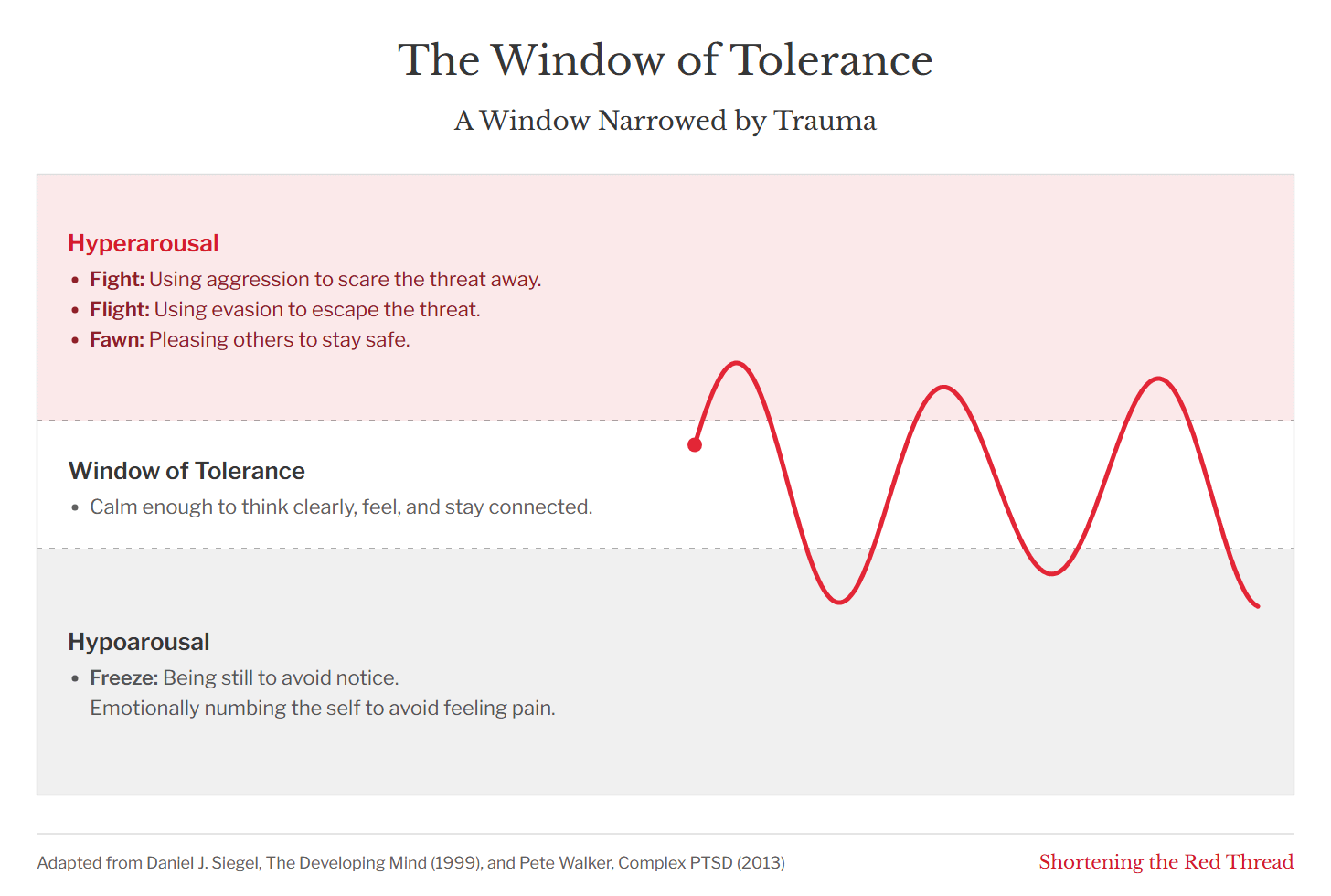
A narrow window leaves no room for choice. The moment something painful happens, the body decides for you, and you are already reacting before you know what you are feeling. Many of us live here for years and assume, as Wolynn puts it, that it originates with us. But you have to remember his book is titled “It didn’t start with you” for a reason.
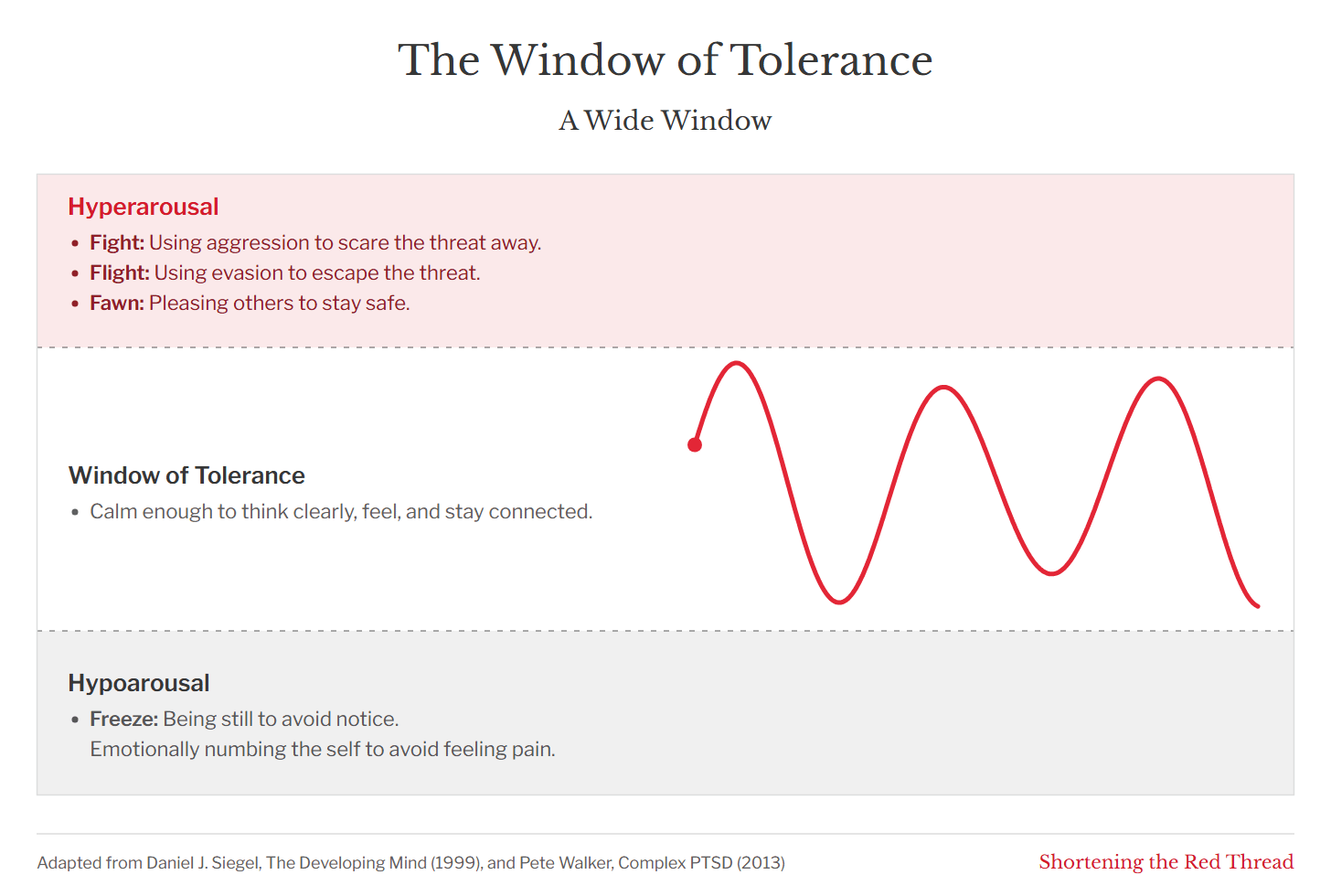
A wide window does not stop the painful moments from coming. It creates space between what happens and what you do about it, and when something does push you out, you find your way back sooner. That space is where the presence of choice lives.
The window widens slowly, through practices that teach the body it is safe, like steady sleep, movement, breathing, and time with people who help you feel calm, and through understanding where your reactions come from in the first place.
In Finding Love After Alienation Part 1, I introduced a framework I call the 5Rs: Recognition, Reconnection, Reclamation, Rebuilding, and Reintegration.
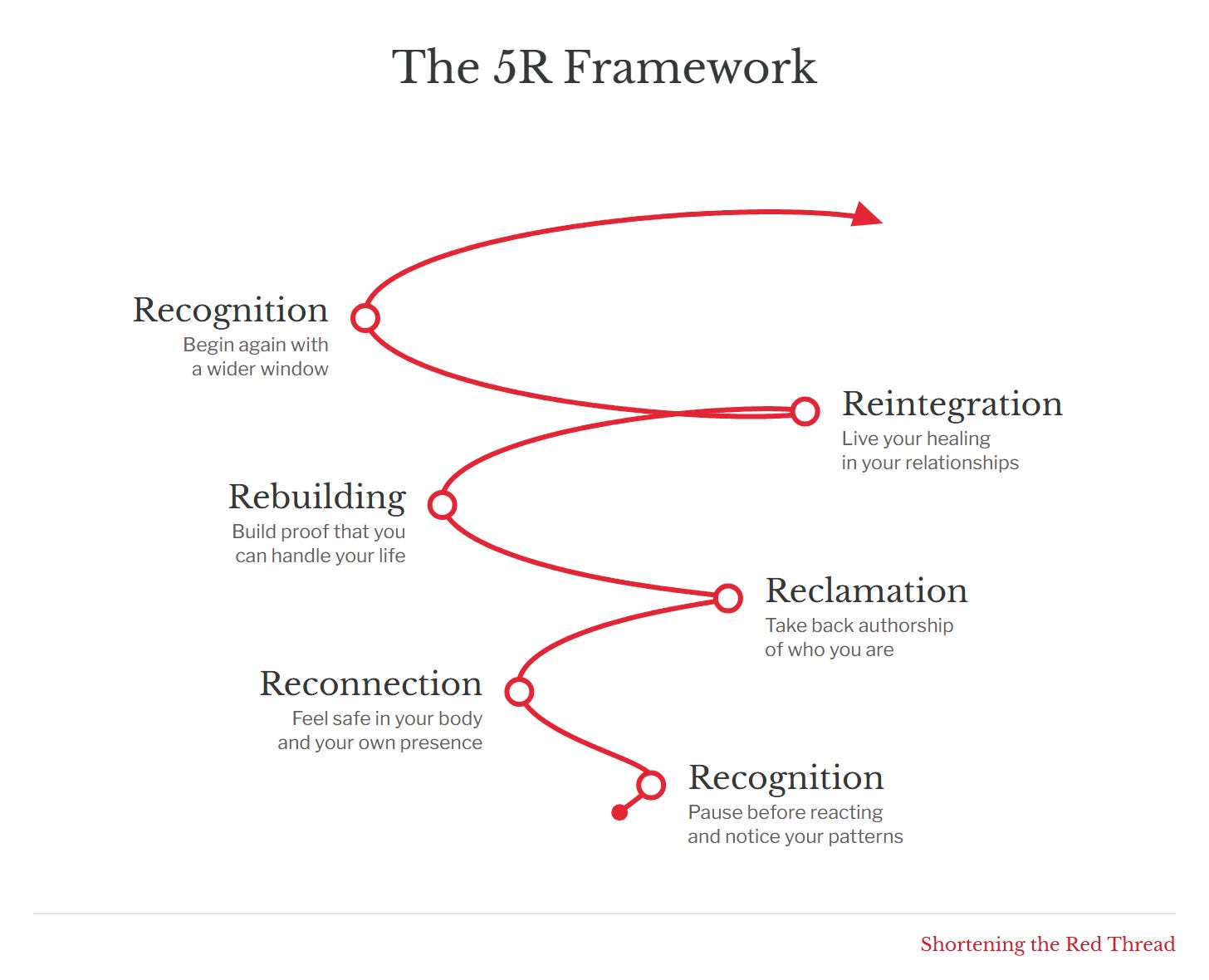
Recognition is the practice of creating a pause between what happens and how you react. For a targeted parent, this might mean reading a cold one-word text from your child and noticing the urge to send three paragraphs explaining yourself before you actually send them. Once you are able to recognize these patterns within yourself, you can start exploring them from a lens of curiosity.
Reconnection is learning to feel safe in your own body and your own presence. Many targeted parents live in a constant state of alert, bracing for the next canceled visit or court filing, and eventually stop noticing what their body is telling them. Reconnection means noticing the somatic and emotional reactions you are experiencing, connecting with them, and learning to accept them so you can release them afterward.
Reclamation is taking back authorship of who you are. Alienators will try to box you into an identity of their choosing, calling you dangerous, crazy, unstable, addicted, narcissistic, irresponsible, etc. Your own upbringing may have assigned you roles, like the fixer or the peacekeeper. Reclamation means deciding what kind of parent and person you are, and holding to it regardless of how you are described by others. Here you reclaim the identity that you want for yourself.
Rebuilding is creating proof that you can handle your life. This comes from small, repeatable systems built around your values, like consistent healthy sleep, regular exercise, a support group, or other practices that help you develop in the area you are healing in. Each one gives you evidence that you are capable, even when the alienation makes you feel powerless.
Reintegration is bringing your healing into your relationships. Your child experiences it as a parent who stays calm when they push you away and is still there the next time they reach out. Your ex experiences it as someone who can no longer be provoked into the reactions that feed the alienating story. Over time, the people around you begin to adjust to the person you have become.
The five steps repeat as a cycle. Each time you move through them, you come back to Recognition with a wider window than the time before. This process starts with the smallest steps and over time, you compound them into tackling the bigger challenges. You cannot heal the wounds of alienation in one cycle, but you can take on the smaller fears first.
Every cycle starts with Recognition, because a pattern has to be seen before it can change. For many of us, the patterns we react from were handed down by parents who never had the chance to see their own.
The questions below are built for those first few steps: tracing where your reactions came from, how they passed to you, and how they show up with your child today.
Start Here
Take a notebook and answer these in writing, one stage at a time (or type it out digitally if you prefer). Write the first thing that comes to mind. You do not need to answer every question or finish in one sitting. This is not a homework assignment and there is no grade. Some of these may not even apply to your situation. If a question touches something too big to face right now, skip it and start with something smaller. You can come back to it later.
As you write, pay attention to what happens in your body. If you notice yourself getting flooded, numb, or checked out, stop, name what you are feeling, and come back when you feel steady.
Stage 1: Your Parents
Every parent was a child first. Before you can see what passed to you, it helps to see what wounds your parents were carrying and how they handled them. Most parents do not talk about their hardest experiences directly, so pay as much attention to what was left unsaid as to what was said. If you do not know an answer, write down what you suspect and note the gaps.
What was the hardest thing that happened to each of your parents before you were born?
How did they talk about it: often, never, only in anger, or only as a joke?
What did they do in place of talking about it?
What did they promise themselves they would do differently from their own parents?
Stage 2: What Passed to You
The first question comes from Wolynn, who found that the first words we use to describe our parents carry the feelings we stored as children. Write quickly and do not filter anything.
Write five words to describe your mother and five to describe your father when you were growing up.
What fear did one of your parents carry that you carry now?
What were you told you had to earn that you now think was really about something else?
Stage 3: How It Shaped You
Many of us spend our adult lives either repeating our parents or doing the exact opposite, and both are ways of reacting to them. These questions look at how your inheritance shows up in your choices, your relationships, and your temper today.
What do you do the opposite of your parents, on purpose?
What do you still do the same way, even though you swore you wouldn’t?
What kind of partner have you been drawn to, and which parent did they resemble? (I wrote more about this in Finding Love After Alienation Part 1.)
What makes you angry fastest, and what does it remind you of?
When you are frustrated with yourself, is there a persona that takes hold of how you believe you should be conducting yourself?
Stage 4: Your Ex’s Inheritance
This stage asks you to look at your ex’s history the same way you looked at your own. The purpose is to see more clearly what your child is living with, and how the fear your child carries may have started generations before them.
What do you know about your ex’s childhood: who they lost, who left them, and who was cut off? Is there a history of alienation in their story?
What fears drive your ex? Whose life did that fear start in?
What role is your child playing for your ex right now, and what role did your ex play for their own parent?
What does your child need from you right now that your ex can’t give them?
Note: I recognize the difficulty of answering these questions as it humanizes your alienator, especially with the harm they have brought to you and your family. If it is not feasible to answer these kinds of questions now, just do it another time when you feel more prepared to do so.
Stage 5: Two Readings of You
Right now, your child’s view of you is shaped by the alienation, and it will likely change if they leave that environment. These questions separate the borrowed story from what your child will see when they look back, and help you decide who you want them to find.
Which of the words your child uses about you sound like the other parent’s words?
What real habit or moment of yours does the alienating story grow from?
Which labels has the alienating story given you, and what would you choose to be known for instead?
What pushes you out of your window of tolerance during a visit, and what brings you back to a calm executive state?
What do you want your child to find, when they look back, that you built for them on purpose?
When you finish, set your answers aside for a few days, then read them again. Look for the fears, roles, and reactions that show up in more than one stage. You may find recurring themes in your story that show room for personal growth.
For example, I am someone who used to struggle with anger after the alienation. I felt incredibly angry at myself for my role in the alienation, even though I knew I was led astray as a child. Processing that anger took several years, ultimately reaching a moment where I learned to let it go because I realized that the anger was an emotional reaction to not feeling in control of my own life. But it was not as simple as just waking up one day and saying, ‘I am letting it go.’
In many ways, it came from asking myself whether anger was the emotion that would give me the outcome I wanted. I would draw wisdom from the Eastern ideals of the martial arts masters, because I desperately wanted to feel inner peace. So part of my journey of letting go of anger was exploring the lessons and wisdom of martial arts philosophers.
This process of personal development is not something I can articulate in a templated process because it is going to be unique to your own experience and philosophy. Some may draw wisdom from religion, their community, or even fictional stories. The key part is looking for the qualities that you want to embody, and slowly shaping your behavior to embody those qualities.
If you want to be someone creative, then do all things with a creative lens. If you want to be more confident, build your skills so that you have something tangible to feel confident about. If you are a people pleaser, start practicing the art of saying no.
The world has everything you need, but the only way to start this process of growth and letting go of the trauma you were handed at birth and additionally, what you have acquired in your life, is to see it first and commit to taking action.
Concluding Thoughts
“Someone once said that every man is trying to either live up to his father's expectations or make up for his father's mistakes, and I suppose that may explain my particular malady as well as anything else.”
~ Barack Obama, The Audacity of Hope
I think about this quote a lot because in many ways, my life now is possible because I took corrective actions to my father’s mistakes. I don’t blame him. He made the best decisions he could with what he had available. Frankly, I don’t think blaming him would help anyway.
It is not my place to judge my parents or even my alienator for their behaviors. I think once we fall into the realm of judgment, we end up minimizing the consequences of our own actions, and that is what passes trauma to the next generation.
As a new father, I have come to see my role as more than just providing wisdom, love, and financial support. My daughter will have her own difficulties I am sure. And there may be traumas that occur due to my own ignorance or events outside of my control. I cannot imagine what alienation did to me on a genetic level so don’t forget, she has half of that. Research has found that men who experienced abuse or high stress as children show chemical changes in their sperm, on genes tied to brain function and in molecules that help guide an embryo’s early development.4 Scientists do not yet know whether those changes shape a child the way they do in mice, but I think about the possibility that my daughter inherited some of what alienation left in me.
So if there is one gift I hope to give my daughter—beyond the gifts of love and my personal experience—I hope to teach her anti-fragility—to become stronger in the face of adversity and to be grounded enough to believe in herself even when the odds are stacked against her.
I like to think that collectively as parents we all hope to instill this within our kids—the tough part is we have to embody it ourselves first because kids learn from our actions more than our words.
I remember the stories my father would tell me about his life and each time he would end it with: “Learn from my mistakes!”
But the mistakes I learned from the most were the ones I witnessed as a child. They were the mistakes that catalyzed events that snowballed into predicaments that I intend to never experience again.
This does not mean or imply that as parents, we must be perfect. That is not possible. But we can be anti-fragile, curious, and committed to doing better than we did yesterday.
No one will notice the growth in a day, week, month, or even year. But over time, the compounding effect will be so great, that your child will hold it as a standard to live up to and one day surpass.
Updates on the book
Book progress has been slow, largely due to some personal challenges at work, but I am still deep in the research phase of the core methodology that I want to teach.
One way you can help is to fill out the survey if you are a currently alienated parent or grandparent. This will help me better understand the challenges you are experiencing and see what underlying patterns are present in alienation cases. Also if you can share it with other communities, that will help spread the word more and I can better produce a book that makes a tangible difference in the reunification process.
I have also been networking with more people in various alienation organizations to get their perspectives on the current alienation landscape so these smaller foundational steps, while slow, are paving the way forward for what I hope to be a powerful tool for targeted family members of alienation and the survivors that heal from it.
As always, if there is an article or topic you would like to see, do not hesitate to comment it below.
Until next time,
Andrew Folkler
Liked this article? Here are other articles you may be interested in:
How to Support Your Alienated Child When You Cannot Fully Protect Them
How to Talk With Your Alienated Child When They Don’t Want to Talk To You
Are You a Writer on Substack?
If you write about alienation or estrangement, let me know! I would be happy to exchange recommendations to better support our readers.
If you are a general reader who writes about other topics on Substack, please consider recommending Shortening the Red Thread so that other parents can find this newsletter and get the support they need to reunite.
As always, I deeply appreciate your support, and I am grateful for your feedback as I develop these articles.
Dias, B. G., & Ressler, K. J. (2014). Parental olfactory experience influences behavior and neural structure in subsequent generations. Nature Neuroscience, 17(1), 89–96. https://doi.org/10.1038/nn.3594
Yehuda, R., Engel, S. M., Brand, S. R., Seckl, J., Marcus, S. M., & Berkowitz, G. S. (2005). Transgenerational effects of posttraumatic stress disorder in babies of mothers exposed to the World Trade Center attacks during pregnancy. Journal of Clinical Endocrinology & Metabolism, 90(7), 4115–4118. https://doi.org/10.1210/jc.2005-0550
Siegel, D. J. (1999). The Developing Mind: Toward a Neurobiology of Interpersonal Experience. Guilford Press.
Roberts, A. L., et al. (2018). Exposure to childhood abuse is associated with human sperm DNA methylation. Translational Psychiatry, 8, 194. https://doi.org/10.1038/s41398-018-0252-1