

“To be, or not to be, that is the question:
Whether ‘tis nobler in the mind to suffer
The slings and arrows of outrageous fortune,
Or to take arms against a sea of troubles
And by opposing end them.”
~ William Shakespeare, Hamlet
The Trolley Problem

The trolley problem is a well-known thought experiment in moral philosophy that highlights the tension between utilitarian reasoning and moral duty.
Imagine a runaway trolley speeding down a track toward five people who cannot escape. You stand next to a lever that can divert the trolley onto another track where only one person stands. The dilemma is whether you should pull the lever, sacrificing one life to save five, or refrain from acting, allowing the trolley to continue on its course.
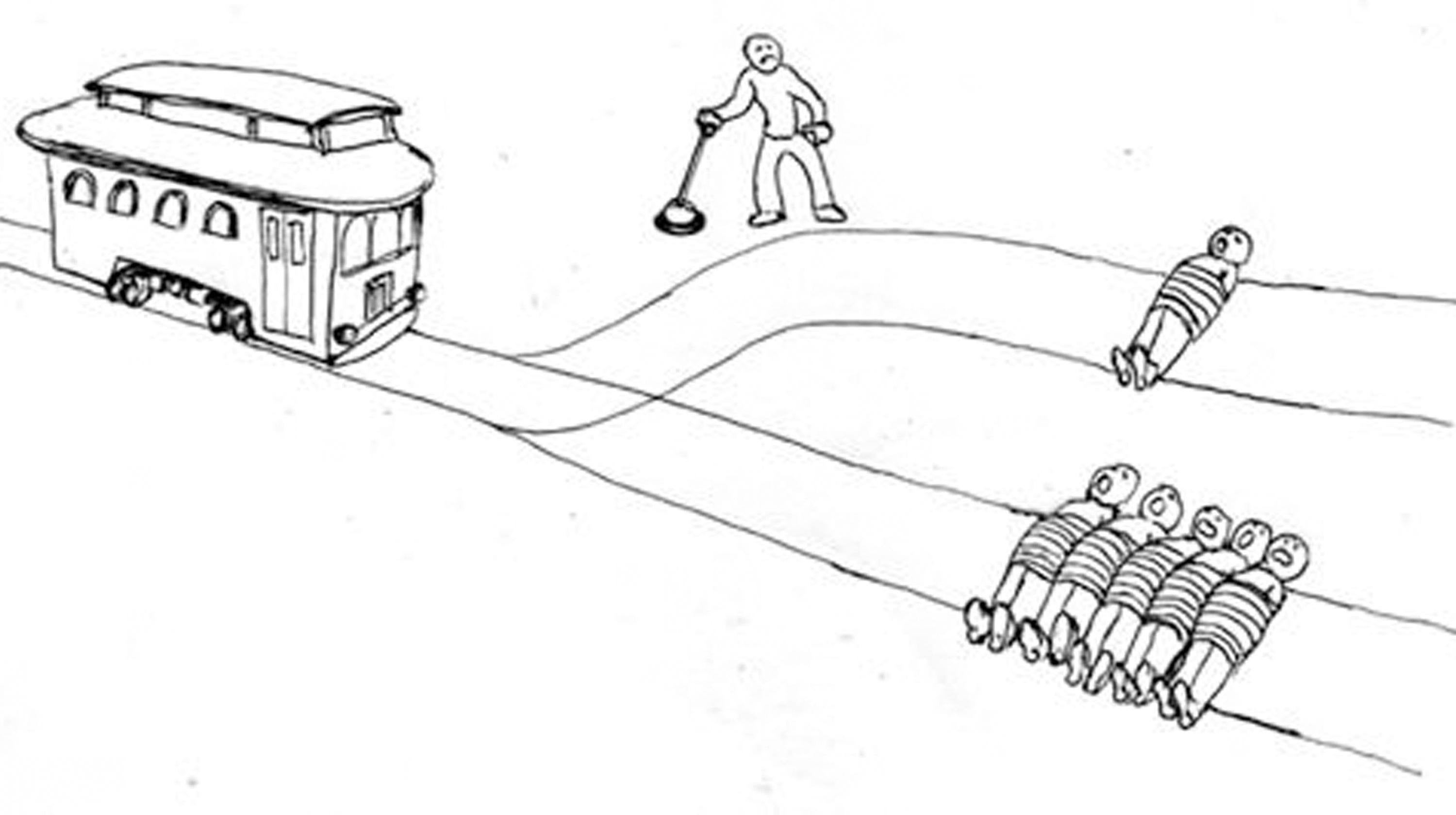
On the one hand, a utilitarian perspective argues that pulling the lever is justified because it minimizes total harm—one death rather than five. On the other hand, a deontological view maintains that actively causing harm, even for a greater good, is morally impermissible, which means that choosing to pull the lever makes you directly responsible for killing someone. Ultimately, the trolley problem is not about finding a single “right” answer but about exposing the moral frameworks and psychological intuitions that guide human decision-making.
Alienation has its own version of the trolley problem, regarding the child's outcome.
For the alienated parents, the trolley represents the alienation of their child, and the trolley problem for alienated parents plays out in two tracks, each with no guarantee of reuniting with their child.
On one side is the legal route. The parent can go through family court, investing enormous time and money, and risking debt, all while exposing the child to escalating conflict, stress, and intensified alienation. There is no guarantee the parent will win custody, and even if they do, alienation can still occur if the alienator maintains close proximity.
On the other side is the non-legal route, where a parent walks away, with the hopes that their alienated child will understand when they are older. This may protect the child from immediate distress from the family court system, but it carries serious risks, including limited or no access to the targeted parent for an indeterminate period, or the child believing the parent never fought for them. The child may go into no-contact mode and believe their parent is unforgivable for sins they may not even have committed. There is no guarantee that the child will learn the truth when they are older, and some parents have gone years or even decades without ever having a conversation with their child.
In either direction, the parent must choose under uncertainty, knowing that both paths are fraught and neither ensures the child’s well-being or eventual reconciliation. The child is highly likely to experience alienation in some capacity, and the thought alone terrifies parents to the point of freezing in place.
I will go through each track in greater detail.
Track 1: Battle it Out in Family Court

Note: I am not a licensed attorney and nothing I share below is to be considered legal advice. Before you make any legal decisions, be sure to consult your attorney or other licensed legal experts.
One of the first people I contacted in preparation for this article was Ashish Joshi, an attorney in Michigan who specializes in Parental Alienation. He is the author of the book Litigating Parental Alienation, which can be a valuable resource for attorneys seeking to better address cases involving alienation.
Ashish pointed out that, regardless of the choice you make, the first step is to take an objective look at the facts.
Here are some questions he shared that a parent would need to consider before even committing to stepping into family court:
How severe is the alienation?
Does the rejected/targeted parent have any contact with/access to the child?
Is the child otherwise stable, e.g., doing well in school, no self-harm behaviors, no substance or drug abuse, etc.?
How close is the child to the age of emancipation?
What reunification options are available in the geographic area where the parent/child is located, and are these professionals trained and skilled in the alienation dynamics?
Have the parent and child undergone prior reunification efforts, and if so, how did it turn out?
And last but not least, is the state in which the parent and child are located, and whether that state is friendly to the concept of parental alienation—e.g., a New York court may view the issue very differently from a court in California?
These questions are no doubt the tip of the iceberg. In addition to specific events and elements in your legal case, you also have to consider your available resources, given the costs. Legal battles require time, emotional energy, and substantial financial resources. Sometimes, the alienator is the person with more resources, and they may engage in legal battles to beat you through attrition.
It is common to hear stories of alienated parents sharing how they spent thousands, sometimes millions of dollars on legal action that amounted to nothing. Parents have ramped up their personal debt, spent their 401k and other retirement funds, and may have even dipped into their alienated child’s college just to be told by the court that they only get supervised visitation.
Now, if you have already committed to a legal battle, you have to be able to approach your legal situation from an emotionally detached position so that you can make strategic moves to support your case.
The last thing you want to do is to spend all this time, energy, and money on a legal battle and lose, and then turn around and blame the lawyer for not doing enough when you had no chance of winning in the first place.
If that last sentence makes you mad, I get it. I was once in this position too. In 2015, I dropped out of college and worked overtime in retail to send my paychecks to a lawyer in Singapore during my youngest brother's custody battle. And when we inevitably lost, we got bitter and blamed the lawyer.
However, we never once paused to evaluate our legal strategy. Nor did we ask the attorneys what our chances of success were. We were highly emotional, bitter, and angry, and we were juggling financial and medical challenges—so you can imagine we were far from ideal clients.
We thought that if we told the lawyer what we wanted and pointed them in that direction, they would do exactly as we asked if we paid on time. And it just doesn’t work that way. If we had any actual chance of winning, we would have won.
How do you know if the legal route is the right course to take?
You must examine the facts of your current situation objectively and evaluate whether you have a strong case that demonstrates you as the more responsible and stable parent. If you don’t know the answer, ask your lawyer what your chances of success are.
You must be able to detach emotionally enough to think strategically with your attorney. Your lawyer is not a social worker, therapist, or spiritual advisor. They strictly deal with legal issues, and you cannot expect them to have the training or capacity to manage your emotions.
You must treat your lawyer as a strategic partner, not an order-taker. While it is important to have goals for your divorce and custody agreements, you cannot expect your attorney to miraculously conjure the results you expect. If it were that easy, everyone would be a lawyer.
If you choose the legal route, keep in mind that your children will experience heightened stress from the alienator and any court proceedings that take place.
Track 2: Walk Away and Hope for the Best

Most people who choose this path do so because they ran out of options. When the money runs dry and energy is depleted, parents are ready to throw in the towel and hope their child learns the truth one day.
If anything, this is where the myth of a child returning at 18 comes from. Overly hopeful individuals will select an arbitrary date (e.g., the day the child becomes a legal adult) and designate it as the day marking the beginning of reunification. Then the day passes, and nothing happens. While the thought might temporarily give the parent a sense of control, the reality is far more agonizing. Years can go by, sometimes decades, and the parent eventually loses all hope.
Other parents find themselves devising strategies to attract their child’s attention and to alert them to the truth. Some try to tell their child they are being brainwashed, only to be immediately bombarded with hateful responses. They might send friends or family that the child knows to intervene, which undermines that relationship and makes the child angrier.
One common hurdle parents face is a list of “unforgivable sins” that the child holds against the parent. These accusations may be entirely false or embellishments of the truth, though they are often a mix of truth and falsehood.
This can include, but is not limited to:
Adultery, promiscuity, and/or soliciting pornography/prostitution
Domestic violence, sexual assault, and/or verbal abuse
Alcoholism, addictions, gambling, and/or other vices
Laziness, weaponized incompetence, avoiding responsibility, unreliable, and/or neglectful
Psychological instability, mental disorders, and/or emotionally volatile
Financially irresponsible, cannot hold a job, broke, and/or a burden to others
Political, religious, or ideological grievances
Controlling, liar, cheater, embarrassment to the family, failure, abandoning the child, and/or backstabber
Negative events such as police involvement, major fights and outbursts, and/or public embarrassment.
The issue with these accusations is that they are layered in a way that paints a vilified image of someone who is unforgivable and unlikely to change.
If I told you that an individual was a promiscuous, jobless alcoholic who bounces between minimum wage jobs and always has someone to blame, you can easily picture someone you know historically or even in your community who likely fits that profile. If you never meet the accused person (and really get to know them) and go solely on the description provided, you would be none the wiser. That person could have turned a new leaf. Their vices and character flaws might not be as extreme as described.
So your child is placed in a situation where they have this image of you as dangerous to their personal safety. They are punished for communicating with you, which increases the stakes for them. As a result, the child cannot get your perspective or side of the story because they are afraid of the consequences and of the possibility that you might hurt them.
However, there is one way in which the alienator allows communication with you, and they can attempt to validate these accusations… and that is through anger.
Many parents make the mistake of getting defensive here. JADE (justify, argue, defend, explain) does not work here.
When the child accuses you of an unforgivable sin, whether it is true or not, they are engaging in a power game where you are placed beneath them. To attempt to explain your side or communicate logically is to submit to a lower status where your child plays judge, jury, and executioner. The alienator teaches the child this kind of game, and chances are, your child has been the victim of this type of interaction with them more times than they can count.
This doesn’t always mean that your child is intentionally manipulating you to hurt you in the way the alienator does. The easiest way to tell if your child is hurting from a past event or is manipulating you is to see if there is a moving target.
If the child speaks about a specific event or behavior that has harmed them, then reconciliation is still a viable option. Even if their perception is warped by the alienator, they are assessing whether you will take ownership of the impact on them.
I am a firm believer in taking full ownership of the situation, even when external factors are beyond your control. Keep in mind that I am not saying you should apologize for things you did not do. Rather, you can apologize for things at a broad level.
I am sorry that I didn’t handle things better. I am committing to being better moving forward.
I made a mistake, and that is on me. I should not have done that, and I will do whatever it takes to make things right.
I see that you are carrying much of the emotional weight from this, and that should not be your responsibility. That is my job, and I want to help you avoid carrying this.
A good apology takes ownership of the situation and shows a commitment to change. Not only is it the right thing to do, but it also gives them the emotional safety to hear you out in the future. Do not, under any circumstances, give a half-assed apology or a weaponized apology. Doing so will not only further damage your relationship but also lead to them going no-contact.
This includes language like:
I’m sorry you feel that way, but that’s not what really happened… (This is turning an apology into JADE)
I’m sorry for whatever you think I did… (Lack of specificity will anger the child more.)
Okay, I’m sorry. Can we just move past this now? (This shows dismissal of the child’s concerns. They won’t take you seriously if you don’t take them seriously.)
I apologize for my reaction, but you pushed me to my limit. (You cannot blame your child for your emotions)
I’m sorry if I hurt you, but you have no idea how much this has destroyed me. I’ve been suffering too. (Your apology should be entirely focused on them, not you.)
I’m sorry, but you have to understand I did the best I could. (The child does not care about how hard you tried. They want to know if you will commit to doing better.)
I’m sorry, but that is not how I see it… (Dismissing their perception, even if it is way off, will only lead them to ignore yours.)
Now, some parents reading this might think, “Why should I apologize for something that is not my fault? The alienator started all of this…”
And the thing is, they could be 100% right. But that doesn’t change the situation because the child is in a place where the alienation process has harmed them, and they believe it is your fault.
If you want to advance your communication with your child, they need to know they can trust you. An untrustworthy person might apologize, but they never take ownership. You already see this in your day-to-day life. But there is a very different energy around someone who takes ownership, even if external factors beyond your control are dramatically limiting your options.
When I reunited with my mother, she apologized for many things:
I am sorry for not always being there for you, but I can be here now.
I am sorry things happened that way with your dad, but I will always be here for you.
I am sorry that I couldn’t talk to you back then, but I will always be available to talk now.
At first, I didn’t give these apologies much attention. Once I learned more about her side of the story, I was blown away by how much she was taking ownership, given that so many things were outside her control. I thought I should be the one apologizing for not giving her a chance sooner.
She demonstrated a humble and dignified manner of carrying herself, even under tremendous stress and pain, setting an example that I strive to emulate.
Now the apology only helps if the child is speaking about something specific to their experience. If there is a moving goalpost, then you know they are engaging in a manipulative tactic.
Suppose they accuse you of one thing and you apologize. If they then accuse you of another, the apology was never the goal. As I mentioned earlier, the child is engaging in a psychological game similar to what the alienator uses on them. It could be a product of enmeshment with the alienator, as a form of self-protection or a safe release of pent-up emotion.
No one likes to be a punching bag, but there is honor and compassion in holding a space for them to release their negative emotions. (This is why I titled a previous article The Crucifixion of the Modern Parent. I am not a Christian, but the metaphor of carrying the sins of your children really nails what is expected of the modern parent.)
So what do you do if your child creates a moving target and is not ready for a genuine apology?
You set a boundary and stand by it.
A grounded response may look like: “I want to repair our relationship. When you’re ready to talk about something specific that hurt you, I will listen, take responsibility where it is mine, and work to make it better. But I can’t engage in conversations that continually shift or attack who I am as a person.”
Reminder: A boundary tells the other person what you will do if specific conditions are not met.
As I mentioned in the introduction, the most painful part of this pathway is the waiting. There is no guarantee when or if the child will reunite with you, and many parents and grandparents have gone decades without contact with their child.
Personally, I do not like the idea of waiting and hoping for the best. Yes, it is good to tell your child that your door is always open to them, but there are other things you can do.
That is why I propose a third option that alienated parents often overlook. It will not yield immediate results, but committing to it will empower you and your family in a compounding way.
The 3rd Option - Active Preparation for Reunification
In preparation for this article, I spoke with Ginger Gentile, director of the documentaries Borrando a Papá (Erasing Dad) and Erasing Family, and now alienation coach at Reversing Parental Alienation.
I have long been a fan and friend of Ginger, and our strategies and methodologies for supporting alienated parents are closely aligned.
During my interview with her, we discussed the 3rd option available to parents. While it may sound similar to the second track, it differs in principle because it is active rather than passive.
I included the link to the interview below.
You are not waiting for them to return. You expect them to return, and you are preparing for that day. While you may not know when they will reach out, you fully intend to be prepared to receive them when they do.
Active preparation means you are:
Healing your trauma so that you are not emotionally triggered by the alienator or your child’s outbursts.
Developing strong communication, leadership, and emotional regulation skills so that you are a reliable and stable person that your alienated child can depend on.
Building a beautiful life. A child does not want to reunite with a parent who is caught in a maelstrom of chaos and dysregulation. Show your child what courage and strength look like in the face of adversity.
Leaving breadcrumbs for your child to follow. As your child gets older, they will start to explore their curiosities on their own. A website with their name is one way you can reconnect with them (if done ethically).
Repairing other disrupted family relationships first. If you have broken relationships with your own parents, siblings, or close family, healing those relationships increases your emotional capacity and often shifts the dynamic with your alienated child. Kids notice when you genuinely grow.
Stopping the martyr narrative. Kids don’t want a parent who “suffered for them.” They want parents who are emotionally present. Martyrdom entails an emotional burden for the child.
These tasks are not easy, and they do not yield results immediately. As a consequence, many alienated parents delay or avoid doing this kind of work because they believe that it doesn’t help.
But the fundamental principle is true here, just like in all things. Small daily efforts consistently outperform a single large effort.
There are a few caveats here.
Given the severity of alienation, you will be required to maintain a high level of emotional regulation and to execute leadership and communication skills with precision.
That is because alienation dynamics are volatile. Half-hearted regulation, occasional skillful communication, or sporadic “trying hard” won’t change your situation. You cannot rely on luck to reunite you with your child.You cannot “win” by educating them into the truth.
If your goal is to prove you were right, debunk lies, or be vindicated, you will lose the relationship even if you win the argument.Do not do this alone, and choose your support wisely.
Bitterness-based support groups and rage-driven communities reinforce hopelessness and entitlement. You do not want to join a group that pretends to be a support network but is actually Fight Club in disguise. Surround yourself with people who have reunited, people who are healing, and professionals who actually understand alienation.This is not passive “manifesting.” It’s hard work.
Active preparation is not hoping, praying, wishing, or spiritually waiting. You are developing structured emotional regulation and communication skills, engaging in trauma work, and intentionally stabilizing your lifestyle.
Healing yourself is not selfish.
Alienation is like you and your child both having broken arms. If you tell yourself that you cannot go to the hospital to fix your broken arm until your child’s arm is fixed, you will be operating at a much slower pace than you could be. Anyone who goes to hug you or show you love will leave you wincing in pain. Heal yourself first, and you will have the tools and experience to guide your child through their healing journey.
What’s Coming Next?
It is crazy to think that it has already been a year since I started this newsletter. Since January 1st, 2025, STRT has grown to 574 subscribers.
The top three performing articles of 2025 (based on likes, shares, and reads) are:
I was also featured as a guest author in the Kids Need Both anthology, Building Bridges of Hope Vol. 2: Strengthening Co-Parenting and Family Bonds, alongside experts such as Dawn Endria McCarty, Dr. Alyse Price-Tobler, Danica Joan Dockery, John Stenner Hamel Jr., and many others. You can get your copy through Amazon or ask your local library if they have it in their listing.
If you prefer to read just my chapter for free, you can do so here: (Bonus) Building Bridges of Hope Vol. 2: Strengthening Co-Parenting and Family Bonds.
Your feedback has been invaluable in helping me understand which articles empower parents to communicate more effectively with their alienated children. For that, I want to thank you from the bottom of my heart.
As always, feel free to ask any questions, and I may even turn your question into a newsletter.
Book Update
As some of you may know, I have been using this newsletter to share my best ideas for free so that I can help parents find the best strategies to reunite and heal with their children.
While there may be some overlap, I will not be copying what I have already published here into a book. Rather, my goal is to have the book be an A-Z guide to reunification with this substack as a bonus resource.
I want this to be the best and most effective book for parents, and while that is a very high standard, I think alienated parents desperately need something that puts the power back in their hands.
Most books on alienation are academic, which can help understand alienation on a clinical level, but they do not provide parents with the tools they need to reunite. If there are books or resources you have found that have helped you, I would love to hear about them so I can add them to my research list.
For now, I am still in the throes of research. Hopefully, as 2026 progresses, I will have enough saved up to get release forms from my attorney so I can conduct interviews with subject matter experts in the alienation and estrangement field. Then I will begin drafting the book shortly after.
Until then, I have many great topics for future newsletters that I think will really help readers. Please continue to share articles you find helpful with other alienated parents.
Happy New Year, and may the years ahead bring you answers, peace, and pure joy.
Until next time,
Andrew Folkler
Are you a writer on Substack?
If you write articles on alienation or estrangement, let me know! I would be happy to exchange recommendations to better support our readers.
If you are a general reader who writes about other topics on Substack, please consider recommending Shortening the Red Thread, as that helps other parents find this newsletter so they can get the support they need to reunite.
As always, I deeply appreciate your support and am grateful for your feedback as I develop these articles.
when I walked away from any immediate prospects for reunification with my alienated daughter, it was mostly self-protective: I was unwilling to continue submitting my self to her ill-treatment. I knew I had to take some responsibility for how I had been treated (I was the one who kept returning, with the same results). However, It was also always plain to me that her abuses of a once-loved father were only aggravating the harms done to her by the alienation, and causing her the psychological trauma of nearly unresolvable shame.
This article was incredibly informative, I have been actively preparing for reunification and it’s feels comforting to know I am doing the right thing for both of us. Thank you for all that you do !!! Finding your blog has greatly impacted me and helped me to feel a little less in the dark.