

“All the world’s a stage,
And all the men and women merely players;
They have their exits and their entrances,
And one man in his time plays many parts.”
~ William Shakespeare, As You Like It (1599)
Quick Announcement
I have a survey for currently alienated parents and grandparents who are looking to support my research for my book on reunification. If you are comfortable sharing your experiences and your biggest questions, you will help me ensure this is the best possible roadmap for targeted parents.
This survey has two phases. Phase 1 takes about 7 to 10 minutes. Phase 2 goes deeper — about 20 to 25 minutes. Your answers will directly shape what goes into this book. There are no wrong answers. Please read the legal disclaimers carefully. They are required if you choose to take the survey.
Thank you for your courage and support as I research and put this book together. If you have already taken the survey, please share it with others as well.
Thank you.
That is not your responsibility

One of the most common things my wife would tell me early in our relationship was,
“That is not your responsibility.”
When we first started dating she said it often. Now I like to think I am doing better, but every now and then she gives me a stern reminder. As a child, I was told repeatedly that as the oldest, I was responsible for the safety and well-being of my younger siblings. Being the oldest does carry some responsibility, since by virtue of age you have the most life experience. If your younger sibling does something stupid in front of you and you had the means to stop them, more fault is placed on you for not stopping them than on your sibling for doing the ill-advised act.
For example, when we were teens, my middle brother saw a baby cobra in the streets of Singapore. Despite my repeated and stern warnings about the dangers of touching it, my middle brother couldn’t help but channel the spirit of the Crocodile Hunter and tried picking it up with a stick. We had both watched enough National Geographic documentaries about snakes to know the danger (baby snakes have highly potent venom matching adults), but my brother was too excited to think about it logically.
Despite the oath of secrecy sworn between the boys, word got out to my father and my alienator that my middle brother touched a cobra, and as you might imagine, I got in more trouble than he did.
In situations like that, it makes sense to hold the older sibling responsible. However, that responsibility has a reasonable limit, and taking it too far leans into an identity of taking ownership of things outside our control and stepping into the role that our parents should be playing for us.
This was the case for me. I acted as a parent for my siblings to protect myself from getting in trouble while believing that it was an act of compassion. It gave me a great deal of purpose and the determination to endure adversity at a higher level. When we envision ourselves suffering for another person, it is quite easy to say that there is no limit. The person we suffer for is so important that we would gladly give up ourselves for their benefit, and in some cases, we hope they would do the same for us.
Reality, though, is a far different story. When I left Singapore (and my alienator), I felt intensely responsible for several things outside of my control. My youngest brother was still living with the alienator, and while we were being actively alienated from him, I felt a sense of duty to do everything I could to reunite with him. That feeling drove the advocacy work I did early on, which led to burnout and depression.
My father warned me about putting my life on hold while we dealt with the custody litigation over my youngest brother, but I didn’t listen. My middle brother was also living with my father and me, and to him, I became a proxy father figure. My father was falling apart from multiple sclerosis, and I have been told by my middle brother that he saw me more as a father figure than a brother.
I dropped out of college to work, saved up to buy a house for everyone to stay in, and took on the burden of figuring out how to reunite with my youngest brother. When it came to reconnecting with my mother, I took complete ownership there as well, pushing myself to communicate with her regardless of my own fears because I felt I owed her some kind of debt for all the suffering she endured.
These experiences are specific to my situation and personal philosophy, and your child will likely react differently. My middle brother, who is two years younger than me, reacted very differently to the alienation, and that is due to the role he played in the family.
I was a parentified child. My middle brother was the scapegoat, and my youngest brother was the golden child. Each of us remembers the alienation differently, and as adults, we approach our lives differently as a consequence of the trauma.
As a targeted parent, one of your biggest frustrations and fears is not quite understanding what your child is experiencing. You may have heard horror stories about the different forms of abuse, your child likely embellishes stories that paint you as a harmful person, and the ambiguity in between leaves you wondering what is true and what is not. Without any sense of certainty, your mind fills in the blanks with the worst-case scenario, resulting in a downward spiral of dread.
I cannot tell you what your child is going through, but I can say there are ways to peel back some of the layers so you can better understand their experience. One of the core pieces to figure out is which roles the alienator is pushing on them.
Active alienation does not mean your child is hearing how bad a parent you are 24/7. Chances are, your child hears a lot of negativity at first, and then it dies down to a steady level, spiking only when the alienator is afraid of you reestablishing your relationship with the child. Of course, this will likely vary based on the severity of the alienation.
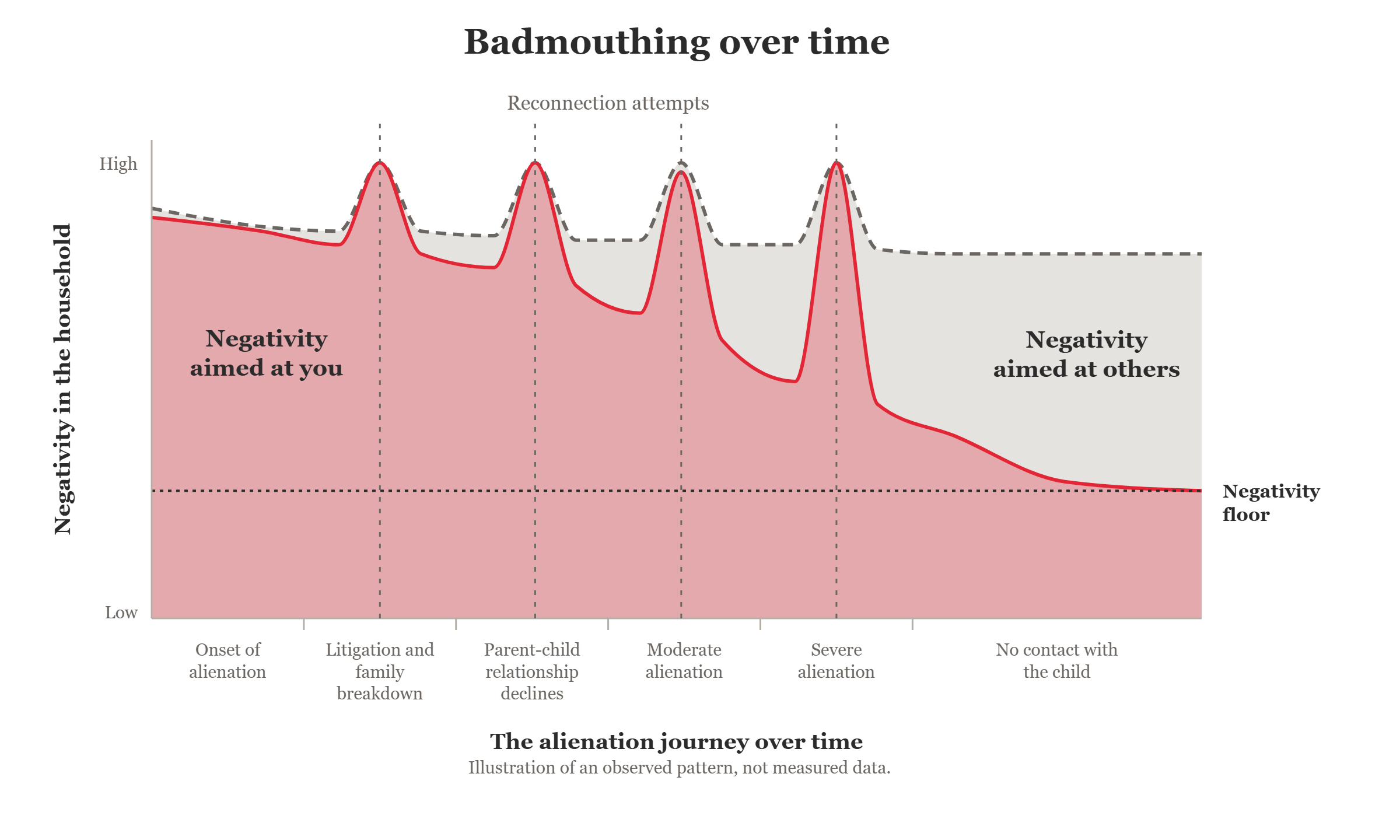
If I were to show what the negativity looked like in my household, the graphic above would best capture it. There was always a high degree of negativity and conflict in the house. It just depended on who the conflict was directed at. When the alienation started for me, the negativity was largely directed at my mother. As the family broke down, the divorce happened, and there was small, intermittent visitation, the negativity would spike depending on the emotions my stepmother was having.
As a result, we became more and more resistant as children to spending time with my mother, because it brought so much conflict. We internalized that conflict as blame that belonged to her. Over time, we moved from moderate alienation to severe alienation and ultimately to no contact with her.
Once you are at the stage of no contact, your alienator doesn’t really need to speak negatively about you as often. With that said, a high-conflict person has plenty of other people in the world to be negative at, so the conflicts themselves don’t go away, they just fixate on someone else. That includes times when she was simply angry at us for failing to meet her expectations or for doing something that went against her values.
The roles that alienated children play go far beyond the alienation itself.
The alienator places roles on each child based on the strengths and weaknesses they perceive in them, so that each child fills a need they have. In my family, the golden child filled my alienator’s emotional needs. As the parentified child, I filled the role of a peer while also handling logistics. And the scapegoat gave the alienator a way to make themself feel better by putting someone else down. These roles will vary depending on the size of the family and the nuances of your family situation.
While alienation is horrific abuse, it is only one component of the larger child psychological abuse going on in the background.
Therefore, a critical part of a parent supporting their alienated child is guiding them away from playing the roles prescribed to them. This is not easy as they have built their entire identity around it. They may likely need the help of a therapist, coach, or other professionals to help them see the subliminal drivers behind their emotional reactions.
Additionally, the roles are not always clear cut. A child who is parentified may be scapegoated sometimes or tasked to act as a golden child. I would say it is situational and sometimes you end up wearing multiple hats. Children who do not have siblings and are alienated are going to fill a blend of roles compared to families with multiple alienated kids.
So the goal of this series of articles is to help you better identify what roles your child is being pushed into so that you can better support them during the reunification process. Because there is so much to cover, I have split this into a three-part series, and each part covers one group of roles, starting here with parentification.
Breaking down the roles of alienated children
In my last article, Inherited Family Trauma, I spoke about how the trauma of your ex’s life shapes the choices and decisions they make, especially their approach to parenting and the alienation process with you.
It is not enough to say they are narcissistic with borderline, sociopathic, and bipolar tendencies. Today, these words carry the same weight as profanity, and they take away your ability to really analyze their behavior.
I have mentioned in several articles the importance of distinguishing judgments from evaluations. A judgment is a label that is given subjectively, while an evaluation can be objectively measured.
Calling someone an asshole is a judgment. Pointing to documented instances where they avoided responsibility, and concluding that they deprioritize their responsibilities in favor of distractions, is an evaluation. You can make inferences from evaluations that help explain the larger picture of your situation.
Note: There is a difference between calling someone a narcissist (judgment) and having them diagnosed by a clinician as possessing narcissistic traits or narcissistic personality disorder (evaluation). One is a subjective opinion while the other is an objective deduction.
In a sense, it is like applying the scientific method to your alienation situation.
I group the roles into three categories.
Parentification: When the child takes on a parent’s job/responsibility to an extreme.
Triangulation (Part 2): When the child is pulled into the middle of the conflict between the parents.
Polarization (Part 3): When children are split into the “good” child and the “bad” child dynamics.
Each category of roles covers the traits you may see in your child, what to look for in your ex, and what you can do right now. Keep in mind that these roles overlap. A child can be parentified in one moment and scapegoated in the next, and an only child often carries a blend of several roles. I will cover these combinations in Part 3.
As you go through them, evaluate both your ex’s behavior and how it shows up in your child. Then you can infer what direction is best for your family.
Parentification of Children
A parent pushes a child into a parental role when they have a need they cannot meet on their own. Some responsibility is a normal part of growing up. For example, if you were sick one day and your child made you breakfast in bed and did some chores, that is perfectly healthy. If your teenager were to babysit their siblings while you were out, that is normal. You want your child to learn to build both the logistical and social skills to care for others so they know how to care for their family and community once they reach adulthood. The family home is the perfect place to explore these different scenarios so that your child has a well-rounded understanding of adult responsibility without experiencing major consequences due to ignorance. While we may all joke about being worried that the kids might accidentally burn down the kitchen when they learn to cook (or worse, burn themselves), there is real risk, and so, we push them to learn the skills to ensure it doesn’t happen.
According to psychologist Gregory Jurkovic, it becomes harmful when a child is chronically expected to meet demands that are “confusing, age inappropriate, burdensome, unsupervised, captivating, or unacknowledged.”1
The separation itself can create the need. Jurkovic lists “parent absence, marital conflict, separation, divorce, and custody disputes” among the stressors that push children into the role, and notes that in divorced families “one of the children may have assumed a parentified role well before their parents separated.”2
The gap can also come from the alienator’s own upbringing. The psychiatrist John Bowlby, whose work founded attachment theory, wrote about parents who invert the normal parent-child relationship and traced it back to the parent’s own childhood. In his words, the parent’s behavior is “a reaction against, or a reflection or residue of, a deeply disturbed relationship that she has had, and is perhaps still having, with her own parents.”3 The family therapist Ivan Boszormenyi-Nagy described the same pattern as a debt that passes down the generations. A parent who never received what they were owed as a child tries to collect it from their own child, and “the extent of his sensed imbalance of justice determines the degree to which he will exploit all later relationships.”4
Dr. Childress describes what this means for the child. In a role reversal, the child’s psychological safety comes to depend “on the child meeting the emotional and psychological needs” of the parent.5 The need can also be tied to a specific trauma or a fear the parent cannot handle rationally, such as a fear of being abandoned, and the child becomes the person who keeps that fear at bay.
Abuse itself also seems to push children into this role. A 2025 study of 701 adolescents found that children who experienced more psychological abuse from their parents took on more emotional caretaking, which the author suggests may be the child’s attempt to prevent further abuse by managing their parents’ emotions.6
As I mentioned in the introduction, I did this often. I acted as a parent to my siblings to keep myself out of trouble, while believing it was an act of compassion.
Parentification takes two main forms, and many children have a hybrid of both.7
In the practical form, the child runs part of the household. They cook, clean, manage schedules, look after younger siblings, or help with work an adult would normally handle. As they get older, they may be pushed into carrying financial responsibility for the household, which Jurkovic includes in this form alongside child care, shopping, and cooking.8
In the emotional form, the child becomes responsible for how the parent feels. They listen to the parent’s problems, calm them down, defend them, and learn adult details about the divorce, the court case, or money. You may hear your child worry about the other parent’s mood or say something like “Mom/Dad will be sad if I stay longer.”
As the child gets older, they may be pulled into conversations about inappropriate topics like the alienating parent’s dating and intimate life or their resentment toward you. It is as if the parent is asking for advice the way they would from a friend or partner.
The most extreme version is when the child becomes a replacement companion and emotional anchor for the alienator. Researchers call this spousification, and you may also know it as emotional incest. Here the child is privy to the deeper thoughts of the parent in the way a marital partner would support them, just without the sex. In this version, the child’s own romantic relationships may be treated as competition for their attention.
The psychologist Patricia Kerig also describes a hostile version, where anger from the marriage spills over onto the child. The parent treats the child as a stand-in for you and aims at the child the anger they hold toward you.9 In a later study of 680 participants, Kerig and a colleague found that this hostile version carried the link between parental conflict and children’s emotional and behavior problems, and later aggression toward their own partners.10
The pairing between parent and child may also matter, though the evidence is limited.
In a 1985 study of mothers and their preschool children, mothers who were “seductive” with a child (the researchers’ term for sensual, role-inappropriate contact driven by the mother’s needs) did so almost always with sons. They were not seductive with their other children, including other sons or daughters, and in a small subsample of six families they were more belittling toward their daughters.11
A 2005 study of 138 families found that mothers who had been in a role reversal with their own mothers were more likely to reverse roles with their toddler daughters, and that when fathers had been in a role reversal with their own mothers, their wives were more likely to reverse roles with their sons.12 Kerig, though, describes the research on gender as inconsistent and concludes that these patterns come more from the dynamics of each individual family than from the child’s gender.13 Jurkovic expected parentification across genders to produce “more matelike than parentlike functioning,” and girls to suffer more, though he offers this as clinical theory rather than a finding.14 Fathers and sons have also been studied far less than mothers and daughters, so the data is not as thorough.15
So for now, treat these as patterns potentially to watch for in your own family.
When you look at your ex, ask yourself the following questions:
What are the things they could not do for themselves after the separation with you?
What was their relationship with their own parents like?
What were they most afraid of and how do they cope with those fears?
How did they ask for help: through guilt, illness, anger, or praising your child for being “so mature”?
Did your child start taking care of them before the two of you separated?
Jurkovic describes parents recruiting a child into the role both directly, through overt neediness, threats, and moral pressure, and indirectly, through a cycle of “engulfment,” then “sudden and often angry disengagement,” then “guilt-laden reengagement.”16 The answers to these questions will point to what they need your child to provide. From there, you will be able to better anticipate how it will impact them into adulthood.
Of the two forms, the emotional one does the most damage. A 2023 review of 95 studies found it had the most consistent link to depression and related problems like anxiety, likely because it asks a child for an emotional maturity they do not have yet.17 In the 2025 adolescent study, emotional caretaking statistically explained part of the link between psychological abuse and anxiety and depression, and the author suggests the guilt and shame a child feels when they cannot meet impossible demands may be part of why.18 Jurkovic describes the same guilt and shame, along with anger and resentment that “typically remain dormant.”19
As the child grows, the role crowds out childhood itself. Parentified adults describe falling behind in school, having fewer friendships with people their own age, and struggling to form relationships as adults.20 Jurkovic adds conflicts about leaving home, careers built around caretaking, and trouble receiving care from others.21
The caretaking career is the one I recognize most in myself. As I described in the introduction, after I left Singapore I took ownership of putting my family back together. I dropped out of school to work, saved up to buy a house, pushed myself to reconnect with my mother because I felt I owed her, and threw myself into advocacy work to reunite with my youngest brother. That advocacy was its own form of caretaking. It was a way of seeking justice, both for myself and for my mother, the parent who had been victimized, and it led to burnout and depression.
One 2025 study linked childhood exposure to alienating behavior with rejection sensitivity in adulthood, where the adult expects to be rejected and reacts strongly to any sign of it. Another linked it with a weaker sense of self that is separate from other people’s needs, which shows up as people-pleasing and trouble setting boundaries.22
The practical form has not been consistently linked to harm, and a few studies suggest it can bring benefits such as coping skills and empathy, especially when the child’s contributions are acknowledged and the arrangement feels fair to them.23 As Boszormenyi-Nagy put it, “Temporary parentification of a child is a normal part of family life and a vehicle for the child’s learning how to be responsible.”24 The harm comes when the responsibility has no limit.
How you can support your parentified child
The role does not end when custody changes or even in reunification. A parentified child carries these habits forward into every relationship, including the one with you. What helps depends on whether your child is still young or already an adult, and on which habits they carried out of the role.
The foundations
1. Acknowledge the role they have carried. Before you change anything, recognize the work your child has been doing. Feeling appreciated and treated fairly is one of the things that protects parentified children.25 Jurkovic calls this step “foundational,” because setting limits before acknowledging the child can feel to them like an attack on the parent they take care of.26 Avoid telling your child they are being used. In my experience, it only makes them defend that parent and dig further into the role.
2. Replace the role instead of just removing it. Caring for others has likely become part of who your child is. The family therapist Stéphanie Haxhe warns against a “care-ectomy” that strips it out and leaves nothing in its place.27 Without a new role, your child may face an identity crisis, not knowing who they are when they are not taking care of someone. The new role is learning to take care of themselves and build their own future. That will feel uncomfortable, because it asks them to put their own needs first, often for the first time. The skills I wrote about in How to Support Your Alienated Child When You Cannot Fully Protect Them, such as financial literacy, sound decision-making, and setting boundaries, give them something to build on, and each one makes the next one easier.
3. Do your own work. Jurkovic found that without addressing the parent’s own family history, “the effects of most, if not all, of the interventions suggested here will not last.”28 The patterns your child is living through may run through your side of the family too, as I wrote in Inherited Family Trauma.
Common challenges and what to do
1. When your child refuses help.
Parentified children often struggle to receive care because they were taught their own needs come last.29 You may hear “I’m fine,” watch them insist on taking care of everything, or see them become uncomfortable when you offer to do something for them.
Start small and low-stakes: small acts of service or gifts, teach them new skills, and show them you value quality time together.
Do not make a speech about it or keep score. The goal is for receiving to feel normal.
Let them give something back, so the exchange feels fair to them and not like a debt.
Tell them plainly that they do not have to earn your help.
Increase the size of what you offer only as accepting gets easier, and expect them to pull back at times.
2. When your child shuts down their own feelings.
A child who spent years managing someone else’s emotions often learns to set their own aside. They may stay calm in a crisis, struggle to say what they feel, or turn every question about themselves into a conversation about someone else.
Do not push them to open up. Pressure confirms that feelings are dangerous.
Ask about their feelings in low-pressure moments, such as on a drive or a walk, when you are side by side rather than face to face.
When they describe what someone else felt, ask how it felt for them.
Name your own feelings simply, so they see it modeled without having to take care of you.
If they describe losing time, feeling unreal, or feeling nothing at all for long stretches, encourage them to see a therapist trained in trauma. That level of numbness is more than a parent can work through alone.
3. When your child pours everything into a partner.
Parentified adults are often drawn to partners they can take care of, sometimes someone with an anxious attachment who needs constant reassurance. Their own goals and friendships fall away while the relationship takes everything.
Do not criticize the partner. It puts your child back in the position of defending someone they take care of.
Ask curious questions instead: what they get from the relationship, what they give, and what they want for themselves.
Show them a relationship where care flows both ways, starting with yours.
I wrote more about how alienation shapes romantic relationships in Finding Love after Alienation.
4. When your child carries their adult problems alone.
In a healthy relationship, an adult child calls a parent for advice or just to share what is going on. A parentified child is used to carrying everything themselves, so you may hear about a job loss or a breakup only after it is over.
Check in regularly without probing, so contact does not always come with questions.
When they do share, ask whether they want advice or want you to listen, and respect the answer.
Stay calm and avoid taking over. How you handle the first small thing they share decides whether they share the next one.
Reuniting with an adult parentified child
Reuniting with an alienated adult is different from reuniting with an alienated child. The usual parent-child hierarchy, where a young child depends on a parent’s authority and care, is gone. Your child may think, “I grew up without you, I learned all of this without you, so why do I need you now?”
With a parentified child, that thought carries extra weight because self-reliance was their job. They spent their childhood as the person everyone else leaned on, and leaning on someone else can feel unnecessary or unsafe to them. John Bowlby wrote that losing a parent can intensify a child’s tendency to give up on wanting love and claim they need no one, a pattern he called compulsive self-reliance.30 When your adult child keeps you at a distance and seems to be doing fine without you, the role may still be running, so keep your door open even when they tell you they don’t need it.
A parentified adult may also still be on duty for the alienator. Bowlby cites a study in which nine out of ten sons who kept living with a widowed mother had a mother who leaned on them emotionally. Some felt they had been made into substitute husbands, and they either stayed single until their mother died or married, divorced, and moved back in with her.31 If your child still manages the alienator’s moods, money, or household, reaching toward you costs them something at home. Changes to that arrangement, such as the alienator remarrying, your child moving out, or your child starting a family of their own, are often when the door opens.
The biggest risk in a reunion is that your child starts taking care of you. A parentified adult will notice your grief, your guilt over the lost years, and your hope for the relationship, and they will try to manage all of it, which puts them right back in the role. The psychologist Joshua Coleman, who works with estranged families, writes that part of a parent’s healing is removing their child from the role of final judge of their worth as a parent.32
My mother handled this well. When we reconnected, she would tell me, “I wasn’t there for you then, but I can be here for you now.” She never asked me to make up for the lost years or to reassure her about them, and when we spent time together, she was present and we focused on whatever we were doing. I came back to her partly because I felt I owed her, and she never treated our relationship as a debt. Today, when she calls, I pick up, and when she wants to talk, I respond.
Here is what you can do:
Tell your child what you can offer now. A line like my mother’s acknowledges the lost years without asking your child to do anything about them.
Apologize for the pain without taking on the alienator’s story. Coleman advises parents to tell themselves that they tried to be the best parent they could, and to tell their child they are sorry “for the ways that you weren’t.”33 In an alienation case, that can be as simple as “I’m sorry for the ways our relationship has been painful for you,” as long as you mean it.
Reach out every so often and ask for nothing back. In a study of adult children and targeted parents who reunited, one adult child said it is easy to go numb to a parent who texts every day, and that their father could not be forgotten because he kept showing up on occasion.34 The researchers concluded that persistent contact that was not overly frequent helped. Ending a message with “no need to respond” makes it easier for your child to answer.
Let your child be the one to bring up the alienation years. Nine of the eleven parents in the same study did not talk about the alienation with their reunited child, mostly because the child still defended the alienating parent. They said they would talk about it if the child wanted to.35
Hold off on “do you remember when…” One adult child in the study called their father a liar when he described memories they could not recall.36
Expect them to pull back after a good stretch. Withdrawing after closeness is often your child grieving what they lost. Coleman writes that an estranged adult child needs to feel sure they can return to the estrangement if reconciling turns out to be a bad idea.37 Stay steady and let them come back on their own.
Grieve the lost years, both yours and theirs. Jurkovic treats grieving what the family lost as its own step in recovery.38
Concluding thoughts
There are countless stories out there where a child takes on a parentified role, be it for other children or for their parents/guardians. Nani from Lilo & Stitch, Katara from Avatar: The Last Airbender, Wendy from Peter Pan, Rapunzel from Tangled, Katniss Everdeen from The Hunger Games, Mulan, Luisa Madrigal from Encanto, Darry Curtis from The Outsiders, Fiona Gallagher from Shameless, and Rory Gilmore from Gilmore Girls.
It happens in real life too. Jeannette Walls wrote about raising herself and her siblings in The Glass Castle, Jennette McCurdy wrote about living as her mother’s emotional caretaker in I’m Glad My Mom Died, and Charles Dickens was sent to work in a factory at twelve while his father sat in debtors’ prison. There are many more.
At the heart of each of these stories is survival. The circumstances for the child were untenable and it forced them to take action to ensure their own survival and that of their loved ones.
As the old saying goes, “Who must do the difficult things? He [she] who can.”
I mean someone has to do it right?
Well, that kind of thinking is a slippery slope. It starts with thinking that you have to be responsible for fixing someone else’s problems and before you know it, you are trying to take accountability for things outside your control.
There is a sweet spot. If we draw out the spectrum of responsibility, one end would be to not take any responsibility at all while the other would be to take on too much. Somewhere in the middle is where we ought to aim for.
The next article will expand on this one by talking about roles involving triangulation. When a parent puts a child between them and someone they dislike (often the targeted parent in alienation cases), the child is forced to behave in ways to protect themselves.
As always, I am happy to answer any questions and I may even turn them into a future article.
Until next time,
Andrew Folkler
Liked this article? Here are other articles you may be interested in:
How to Support Your Alienated Child When You Cannot Fully Protect Them
How to Talk With Your Alienated Child When They Don’t Want to Talk To You
Are You a Writer on Substack?
If you write about alienation or estrangement, let me know! I would be happy to exchange recommendations to better support our readers.
If you are a general reader who writes about other topics on Substack, please consider recommending Shortening the Red Thread so that other parents can find this newsletter and get the support they need to reunite.
As always, I deeply appreciate your support, and I am grateful for your feedback as I develop these articles.
Jurkovic, G. J. (1997). Lost Childhoods: The Plight of the Parentified Child. Brunner/Mazel, p. xiv.
Jurkovic (1997), pp. 29, 67.
Bowlby, J. (1973). Attachment and Loss, Vol. 2: Separation: Anxiety and Anger. Basic Books, p. 266.
Boszormenyi-Nagy, I., & Spark, G. M. (1984). Invisible Loyalties: Reciprocity in Intergenerational Family Therapy. Brunner/Mazel, p. 66.
Childress, C. A. (2015). An Attachment-Based Model of Parental Alienation: Foundations. Oaksong Press, p. 108.
Stanić, L. (2025). The role of emotional parentification in linking psychological abuse and parental conflict to adolescents’ internalised problems. Child & Family Social Work. https://doi.org/10.1111/cfs.70087
Dariotis, J. K., Chen, F. R., Park, Y. R., Nowak, M. K., French, K. M., & Codamon, A. M. (2023). Parentification vulnerability, reactivity, resilience, and thriving: A mixed methods systematic literature review. International Journal of Environmental Research and Public Health, 20, 6197. https://doi.org/10.3390/ijerph20136197
Jurkovic (1997), p. 8.
Kerig, P. K. (2005). Revisiting the construct of boundary dissolution: A multidimensional perspective. Journal of Emotional Abuse, 5(2/3), 5–42, pp. 19–20. https://doi.org/10.1300/J135v05n02_02
Kerig, P. K., & Swanson, J. A. (2010). Ties that bind: Triangulation, boundary dissolution, and the effects of interparental conflict on child development. In M. S. Schulz, M. K. Pruett, P. K. Kerig, & R. D. Parke (Eds.), Strengthening Couple Relationships for Optimal Child Development (pp. 59–76). American Psychological Association, p. 71. https://doi.org/10.1037/12058-005
Sroufe, L. A., Jacobvitz, D., Mangelsdorf, S., DeAngelo, E., & Ward, M. J. (1985). Generational boundary dissolution between mothers and their preschool children: A relationship systems approach. Child Development, 56(2), 317–325. https://doi.org/10.2307/1129722
Macfie, J., McElwain, N. L., Houts, R. M., & Cox, M. J. (2005). Intergenerational transmission of role reversal between parent and child: Dyadic and family systems internal working models. Attachment & Human Development, 7(1), 51–65. https://doi.org/10.1080/14616730500039663
Kerig (2005), p. 20.
Jurkovic (1997), pp. 50–51.
Dariotis et al. (2023).
Jurkovic (1997), pp. 31–33.
Dariotis et al. (2023).
Stanić (2025).
Jurkovic (1997), pp. 54–56.
Dariotis et al. (2023).
Jurkovic (1997), pp. 60–65.
Aharon, I., & Wilchek-Aviad, Y. (2025). Parental alienation in childhood and its impact on adult life satisfaction. Current Psychology, 44. https://doi.org/10.1007/s12144-025-08011-7; Liu, C., & Xiang, J. (2025). The dynamic mechanisms of parental alienation and social adaptation in Chinese college students. International Journal of Adolescence and Youth, 30. https://doi.org/10.1080/02673843.2025.2526460
Dariotis et al. (2023).
Boszormenyi-Nagy & Spark (1984), p. 22.
Dariotis et al. (2023).
Jurkovic (1997), p. 107.
Haxhe, S. (2016). Parentification and related processes: Distinction and implications for clinical practice. Journal of Family Psychotherapy, 27(3), 185–199, pp. 196–197. https://doi.org/10.1080/08975353.2016.1199768
Jurkovic (1997), pp. 120–121.
Jurkovic (1997), pp. 62–65.
Bowlby, J. (1980). Attachment and Loss, Vol. 3: Loss: Sadness and Depression. Basic Books, p. 368.
Bowlby (1980), p. 314, citing Hilgard, J. R., Newman, M. F., & Fisk, F. (1960). Strength of adult ego following childhood bereavement. American Journal of Orthopsychiatry, 30, 788–798.
Coleman, J. (2020). Rules of Estrangement: Why Adult Children Cut Ties and How to Heal the Conflict. Harmony Books, Ch. 11.
Coleman (2020), Ch. 11.
Matthewson, M. L., Bowring, J., Hickey, J., Ward, S., Diercke, P., & Van Niekerk, L. (2023). A qualitative exploration of reunification post alienation from the perspective of adult alienated children and targeted parents. Frontiers in Psychology, 14, 1189840, p. 6. https://doi.org/10.3389/fpsyg.2023.1189840
Matthewson et al. (2023), p. 9.
Matthewson et al. (2023), p. 6.
Coleman (2020), Ch. 1.
Jurkovic (1997), pp. 123–125.
Thank you, Andrew.