

A bright moon rises over the sea;
from the far ends of the earth, we share this moment.
Those who feel deeply lament the long, distant night,
and all through the hours, thoughts of loved ones rise.
I extinguish the candle, cherishing the moonlight filling the room.
I put on my robe, sensing the dew’s dampness in the air.
I long to gather the moonlight in both hands as a gift,
but cannot — so I return to bed, hoping for a good dream of you.
~ Zhang Jiuling, Poet of the Tang Dynasty
The Paper Lantern Festival

In Chinese tradition, families would gather paper lanterns for the Lantern Festival (元宵节), to light lanterns in celebration of the Lunar New Year’s first full moon.
Some lanterns are carried upward by a flame and float into the sky, glowing like stars, while others float down rivers.
Often, these families would write their wishes and prayers on the lanterns. Their colors and shapes also carry meaning. Red is the color of fortune and joy. The round shape of the lanterns represents wholeness and unity, and the dragon and flower designs symbolize strength, beauty, and resilience. Once lit and released, the lantern’s path is no longer in human hands. Wind, fire, or the water currents will determine its course.
It is a tradition still practiced today in which countless people express their intentions for the year and then release them to manifest later.
In alienation, most of your outreach to your child will feel like releasing a paper lantern—a small prayer, hoping you will hear back. Most days will feel like you are wasting your breath and your time. In cases where your child is severely alienated, your child has likely gone no contact and blocked you on all communication platforms.
After years of no contact, the child becomes a stranger, and the parent has no idea what to even say to them anymore.
In extreme cases, the child eventually leaves the alienator’s house, gets married, and has their own kids—all while self-enforcing their alienation, as well as alienating the grandkids from you.
Last month, I spoke about the Alienation Trolley Problem and how parents reach a point where they look at all the effort they have put into communicating with their child and see little to no results. In some cases, they might get a response from their child, but it is a venomous threat, saying never to message them again.
When nothing seems to work, parents slowly stop reaching out, afraid of making things worse.
So what can a parent really do when they are severely alienated from their children?
Start With Detective Work

If you are a parent who has been cut off from your child for several years, you will need to gather information first before approaching them.
Why?
Your outreach should not be random or ad hoc. Virtually every parent whose child has gone no-contact has said the same thing to me… “I don’t even know what to say to my kid anymore…”
So you have to put on your journalist and detective hat and gather insights like:
Contact information
You need to look for their address, school contact info, email address, social media handles, phone number, and any other forms of communication.
The goal here is not to corner your child or overwhelm them with messages. What you need right now are options. Without contact information, you will not be able to continue finding out other information about your child.
In many cases, you can find this information without crossing any ethical or legal lines, simply by checking:
Basic online search.
A search of your child’s full name (and any known nicknames), plus their city or school, may bring up public profiles on social media, personal sites, professional pages, alumni lists, or portfolios.Social media.
Even if they’ve blocked you personally, you may still be able to see public profiles, posts, or profile photos. If not, ask a family member or close friend to let you search for their name using their account. Your child may have multiple social media handles across platforms, or a single handle across all platforms. Most people do not use their name for privacy reasons, unless they are building a brand (LinkedIn and Facebook would be the exception here).
Keep in mind that different platforms have different privacy settings. For example, Facebook limits search results to either Public, Friends of Friends, or Friends. Platforms such as LinkedIn indicate that your profile has been viewed by another profile, but only LinkedIn Premium subscribers can hide their profiles (not recommended due to the high monthly cost).
If you are unable to find your child’s account, see if you can find an account of a friend or family member who would be connected/following/friends with them. Then look at their friend list. If you are afraid you are blocked, create an alternate account and look again.Public records.
For adult children, property records, voter registration data, court records (for name changes or marriage), and business registrations are often searchable through county or state websites. These can confirm a current last name, approximate location, and whether they’ve moved. As a parent, you can typically request copies of your child’s birth certificate through the county office where they were born, which can be helpful if you need to verify identity details or navigate other record requests.School and alumni directories.
For teens or young adults, school websites, team rosters, club pages, or alumni registries may list an email address, city, or updated surname.
As you do this “detective work,” keep two guardrails in place:
Stay within what is truly public and legal.
No hacking, no stalking, no pressuring friends, relatives, or co-workers for private information.Remember the purpose of the search; you are gathering information to approach them respectfully. Do not be intrusive or stalkerish.
You are not collecting data so that you can show up at their job or doorstep unannounced. You are gathering just enough to understand where they are in life and to identify a respectful, low-pressure way to send a future olive branch. If you find a social media profile and rush to send messages, you risk getting yourself blocked. If you show up unannounced at their house, school, or job, you risk a restraining order.
Be respectful of their space, or they will push you out permanently. In extreme cases this can include them intentionally trying to hide from you, intense arguments, and restraining orders.
Once you have a clearer picture of how to reach them—and where they are in their own life stage—you can begin crafting what to say and how to say it.
Other Information to Gather
If you are able to find social media profiles or other sources of information about your alienated child, make a list in a notebook or digital journal and start gathering data on the following:
Life Stage & Stability
Are they in school, working, unemployed, caregiving, or parenting?
Did they recently move? Go to college/university? Graduate? Change jobs? Get married? Have kids?
Are they in a transition season (puberty, college, divorce, relocation, early parenting, medical challenges, etc)?
Likes, Dislikes, and Identity Markers
Your child is a real person, not a memory locked in time. They may not share the same interests as before the alienation. See if they post about their:
Hobbies and interests
Music, books, games, and communities they care about
Causes they support
Values they publicly express
How they describe themselves now
Accomplishments & Growth
Life goes on regardless of alienation, and the child must become an adult. But that doesn’t mean you shouldn’t be proud of their growth, despite all the pain.
Look for:
Education achievements
Professional milestones
Creative projects
Awards or recognition
Volunteer or leadership roles
Many of these things may be posted on the school or university website.
Events & Community Participation
Right now, attending events may not be the best strategy, but it helps to know what your child is participating in. Look for:
Clubs, teams, band or choir performances, speaking events
Conferences or professional groups
Community or cultural involvement
Tone of Their Public Voice
Your child’s online voice indicates their emotional state, sense of self,
Are they humorous? Private? An activist? Guarded? Sentimental?
Do they post openly or minimally?
Do they appear nostalgic, angry, hopeful, or cynical?
Are they relationally or intellectually driven?
What ideologies and values do they stand by?
Getting the Small Yesses to Lead to the Big Yes

So far, all you have done is gather information. If you have jumped ahead and tried contacting them immediately, then you are jeopardizing your chances at reconnection. I understand the emotional pull to reach out, but without discipline or a strategy, you will scare off your kid.
The information you gather will be critical to your communication strategy. I mentioned previously that most parents tell me that they don’t know what to say. When the pressure feels too overwhelming, they send a plain message that signals low confidence and wishful hope that it will start a conversation.
This includes but is not limited to messages like:
Hi/Hello
How are you?
Good morning/afternoon/night
I love you.
Miss you.
How was your day today?
These messages are fine as conversation openers in a normal relationship. But you are trying to contact someone who is avoiding you. They are easily ignored, and they don’t attract the attention of your child.
In more extreme cases, I have seen parents get more desperate with their messages, to the point that it looks like this:
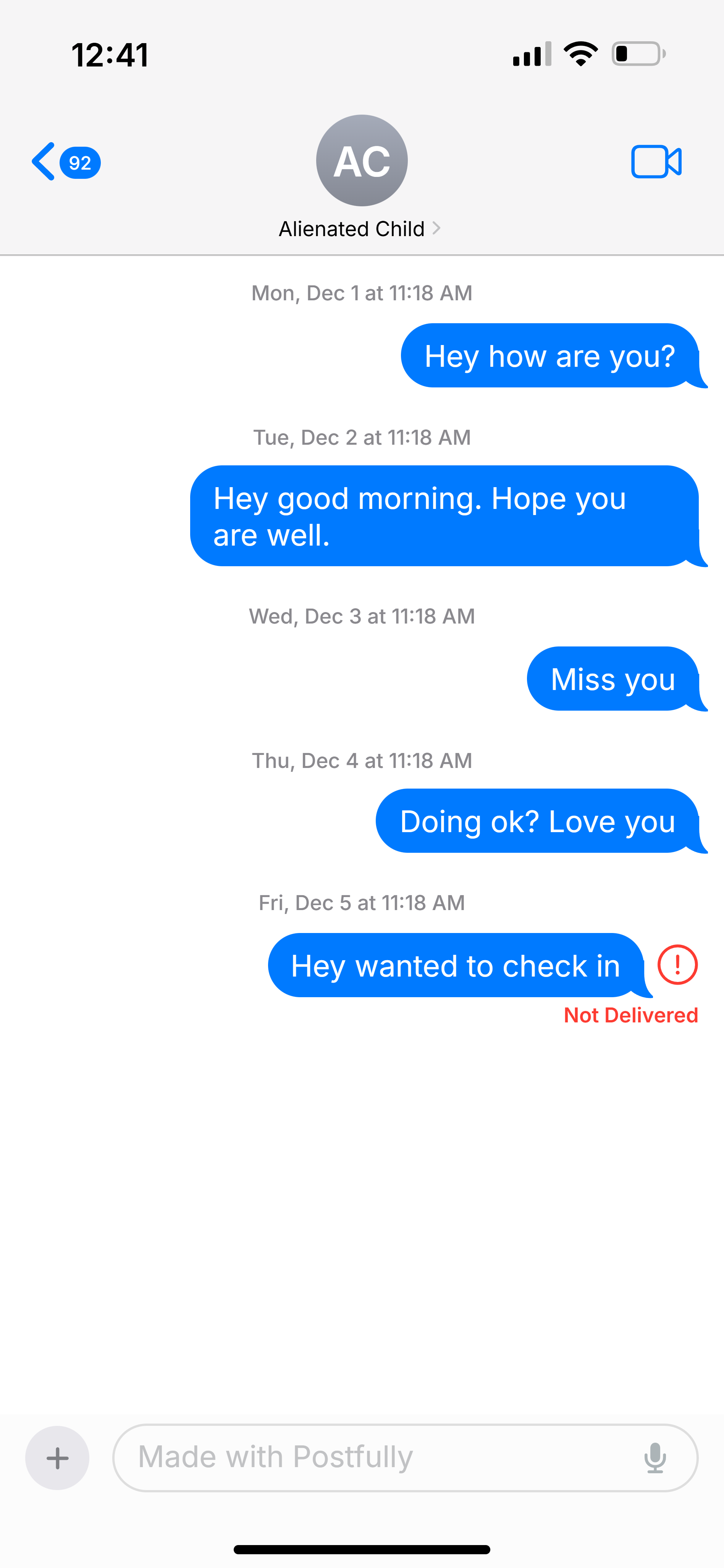
I have seen things like parents typing “I LOVE YOU!!!” multiple times with emojis every day, to just a one-word text “hey” at the same time every day, like an alarm clock.
None of that works. Not even in regular friendships and relationships. This kind of texting gets you blocked immediately.
So how do you communicate with someone who can benefit from what you have, but doesn’t want to talk to you?
Fortunately, I work in marketing, and I do this for a living.
There are a few foundational rules in marketing:
Know your target audience better than they know themselves. (This is where the detective work comes in.)
Speak to the pain points of your target audience. (Interpreting the information you have gathered so you know what your child values.)
Sell the benefits, not the features. (Leading with value for the child, not for you.)
Now you might say, “Andrew, I am their parent. Why do I have to sell myself to my own child?”
Bear with me, and it will make sense in a moment.
You don’t need to be a sleazy carsalesman to get your child to see how great it is to be around you. All you have to do is recognize that sales is about relationship-building and problem-solving.
So let’s break down the rules:
Rule #1: Know your target audience better than they know themselves.
Chances are, you have been researching alienation and its impact on children. If you are still unsure what the alienated child is going through, I highly recommend reading the article below first, then resume reading this one.
Wondering what goes on in the head of your alienated child? Read my article: Seeing through the Eyes of the Alienated Child
The core things to remember here are that your child is likely to be in either a survival state (Am I safe?) or an emotional state (Am I loved?). To guide them, you will need to be able to assess in real time which mental state they are in and the appropriate response to meet that need (either safety or connection).
Of course, there are a multitude of other factors to consider, including their age, current life struggles, the level of abuse and alienation occurring, and the history between you and your child.
Write these things down in a journal or digital notepad so that you can see how each of these factors might be affecting your child’s stress levels, emotional state, and their capacity to succeed in life.
All the detective work I mentioned at the beginning of the article? That comes into play here, too. Context is everything.
Rule #2: Speak to the pain points of your target audience
Every day, millions of people go to the gym to work out. Why? Because the pain of not doing so would be more than the pain of working out. The fear of disease, weakness in our old age, brain fog, and injury is enough to motivate many people to exercise regularly so that they stay healthy and fit for as long as their bodies can handle.
As humans, we are motivated by the avoidance of pain and the pursuit of pleasure.
In the case of your child, communicating with you is likely a source of pain. They may be:
Punished or guilt-tripped for communicating with you.
Interrogated after every conversation (What did you talk about? Did he/she say anything about me?)
Insulted for communicating with you (Oh, so you want to be a liar like your mom/dad?)
Anxious that you may hurt them (Your mom/dad is an alcoholic and they will get violent… or other horror stories)
Conflicted about previously planned engagements. (Soccer practice with my friends vs seeing the parent that I haven’t seen in years…)
Angry about something they were told about you. (The unforgivable sin)
Afraid you will disappear again. (Your mom/dad abandoned you.)
And so on.
Knowing they are in pain and why tells you exactly what to focus on first—providing them with a sense of safety. If I am selling hamburgers, I talk to hungry customers. If I am selling plumbing services, I talk to people with leaking pipes and clogged sewers.
You are selling yourself as a loving parent who can not only give them the support and love they need, but also help them alleviate the pain they are experiencing right now.
If they are afraid of:
Abandonment - you lead with consistent communication and presence.
Physical/Emotional/Sexual harm - lead with consistent virtuous behavior
Punishment for communicating with you or an unforgivable sin - consistent ownership of the situation, so they do not blame themselves.
Interrogation after talking with you - consistent respect for their space and boundaries, while also actively reducing their risk of punishment.
Choosing between prior engagements and you - consistently letting them know you are always there, so they don’t have to feel guilty for not choosing you.
Rule #3: Sell the benefits, not the features.
If you are looking to buy a new computer and the sales guy only talks about RAM, processing power, and motherboards, would that help you buy a computer? Probably not.
But if that same sales guy tells you that you can easily run all your apps, games, or online meetings, the camera shows your face clearly so you look professional, it is lightweight so you won’t have sore arms carrying it, and it has enough storage to hold all your photos, files, and programs… well, now you have a real reason to pay attention.
As painful as it is to read this next statement, I am going to say it bluntly:
Severely alienated children do not know or see the benefits of communicating or being with their alienated parent. That is a direct result of their programming from the alienator, and it is compounded by your absence.
This is one of the biggest reasons I push for parents to treat their own psychological wounds first so that they come forward to their children in a peaceful state. Your peace is one of the many benefits you will bring to them, along with financial and emotional support, and your leadership. It is much harder to help them heal if you are triggered into an emotional or survival state.
All of these three rules are the foundation for the main point I want to drive home.
Many parents will try to get the child to go back to the way things were before the alienation. That version of the child is gone and will never come back. Right now, you have your child who has seen and experienced the harm of alienation, and you have to look at them as they are now.
Rather than try to “Go back to the way things used to be…” you will need to look at where things can go from here.
In the case of severe alienation, you will effectively be starting over, rebuilding your relationship with your child brick by brick. And the best way I can frame that journey is through the analogy of dating.
No one walks up to a stranger and says, “Hi. My name is Andrew. Let’s get married.”
There is no connection, shared experiences, or reason to engage in a long-term committed relationship.
Instead, you start by introducing yourself, then have a short conversation or two. Then you go get coffee, then another small date. Afterwards, you do a fancy date and another, spend the night together, meet each other’s parents, move in together, and do all of this over the course of years before tying the knot.
Yet many parents will ask their child for a high level of commitment without having the emotional connection to justify it. If you are severely alienated and haven’t seen your child in years, asking to meet for lunch is almost guaranteed to fail because they don’t trust you enough. In their minds, they already fear the thought of communicating with you, so a phone call sounds like a huge commitment.
Instead, what you need to do is start so small and granular that they don’t even have to do anything.
This is what I call “Getting the Small Yesses to Lead to the Big Yes.”
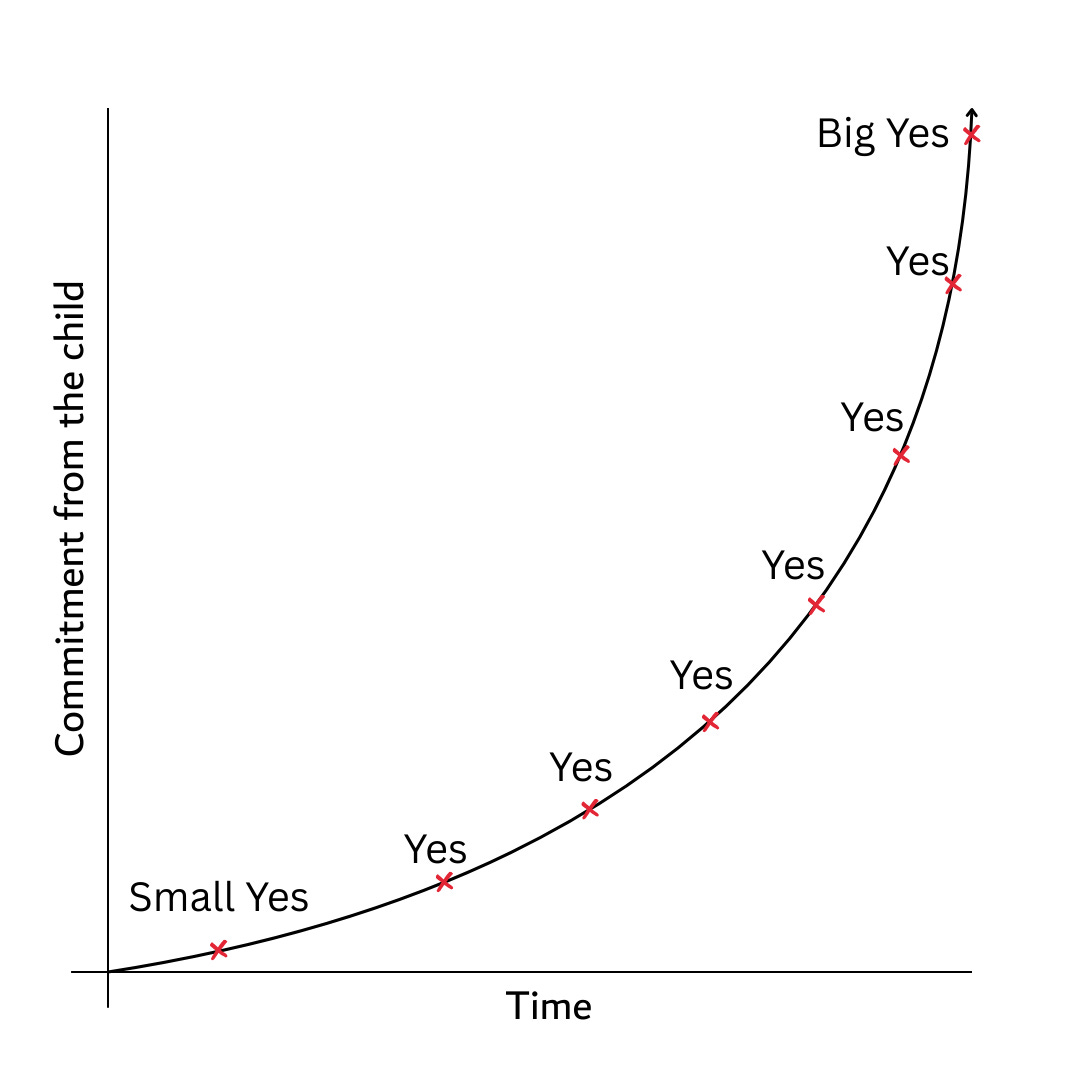
If you can find their contact information (regardless of how alienated they are), look for fun, low-commitment ways to initiate a conversation. If they respond, you have gotten a small yes. You can slowly compound them until you get to the “Big Yes” (reunification).
Instead of “Hey” or “I miss you” or “Good Morning,” you skip the pleasantries and go straight into a topic that has nothing to do with alienation, politics, religion, family, or negative feelings.
At this stage, especially for text communication, your goal is only for the child to see the message. As long as you are not blocked, you can send messages about pop culture, funny memes and pictures, or neutral observations that do not require a response.
For example, you could send a message that says,
“I thought this was funny and figured you would find it hilarious. No response needed. :)”

The icing on the cake here is NRN - No Response Needed. You know already the pressure they face from the alienator, and you are signaling to them, " Hey, I know about what you are going through, and I am not going to ask you to do something that would get you in trouble.
Combined with a meme that has nothing to do with the current situation or family dynamic, the alienator’s pressure is virtually non-existent.
Sure, the alienator might see the message and deride you by telling, “Wow, your Mom/Dad has nothing better to talk about, huh…”
That is okay—they were already going to do that anyway.
Your goal at this stage is to get your child to laugh or smirk. As long as your child sees the message and thinks “Haha, that’s actually pretty funny… ” you win. You got a small yes.
If your child responds, “Stop texting me.” You won, they have seen the message. Wait a bit and try something else that is funny or interesting to them.
Beyond memes, you can also use pop culture. When I was alienated from my youngest brother, I used movies as conversation starters. I would say, “Hey, this superhero movie looks interesting, and I am wondering if I should go watch it. Have you seen it yet? I don’t want to go if it is not that good.”
Or if I did watch the movie, I would say, “I watched this movie today and thought it was pretty good. What were your thoughts?”
If he responded awesome. If he saw the message awesome. The only thing I was measuring was whether he saw it. Sometimes you won’t know until you see a read receipt under the message. If that is turned off (most apps and devices have read receipts enabled by default), you will just have to trust they can see it until proven otherwise. For all you know, they could be viewing it and not responding for months or years, out of fear that their alienator will retaliate if they reply.
There are a million topics you can cover in this domain, and the best part is these trends are always changing as time moves forward, so you will never run out of topics:
Pop singers and Bands – Taylor Swift, Drake, Billie Eilish, or whoever they follow
Movies and TV shows – superhero films, anime, Netflix series, documentaries
Sports – a big game, a trade, a highlight, or a controversial call
Games – a new release, an update, a trailer, or a funny in-game moment
Internet culture – trending memes, short clips, or harmless viral moments
Music – a song you heard and thought they might enjoy
Books or podcasts – especially if you know what genres they like
Everyday curiosities – something odd, clever, or mildly interesting you came across
The key is that none of these topics requires vulnerability, explanation, or emotional labor on their part. You are not asking them to feel, decide, or choose sides.
In a way, you are showing them what a normal life would look like with you in it. These are the kinds of topics you would be talking about if the alienation had never taken place. Instead of talking to them like an alienated parent, “When can we talk? I miss you…” talk like a parent who is still connected, “Have you read this book? I think you would really like it since you like those books. No response needed.”
Over time, these neutral touchpoints do something very important… they decouple you from being perceived as a threat. Instead, you slowly become associated with fun, curiosity, and safety.
That shift in their perception matters more than sending the perfect message. So many parents get into analysis paralysis, thinking to themselves, this message has to be perfect, or my child will disappear. It won’t work like that. There is no perfect message. Some messages will upset your child. All you can do is test and see what works. If you send something they don’t find funny, try again with something else. Ask them about something in pop culture. Just send a message about something small, and if they see it, you win. Their responses will inform what they care about.
One final rule here…do not escalate just because you feel encouraged. A single reply does not mean you should suddenly ask to meet, talk about the past, or “clear the air.” That urge is understandable, but it undermines your efforts. Your child will see your behavior as a bait-and-switch.
If done correctly, without escalation, you will reinforce to your child that you were always there and always loved them. This was the method I used to reunite with my younger brother after he had been severely alienated from me for five years.
Over time, you will go from left-on-seen to one-word answers to short conversations to longer conversations and phone calls. But again, this is a slow process and depends on the severity of the alienation. It took me years to go from left-on-seen to long voice conversations. There is an ebb and flow to it. If they need space, pull back for a while and reappear afterward (the length of the pause depends on the alienation).
Last but not least, in marketing, we say you need a high number of touchpoints or interactions before your customer will buy. This is because customers need to feel familiar with your product and brand before they feel safe buying it. This is why you will always see a Starbucks or McDonald’s down the road (and 4 or 5 in all over your city). Even if you don’t go there regularly, you will always remember their brands because you see them so often.
This does not mean spam your child messages, but again, remember you will stay top of mind if you continue to reach out to them regularly.
Everyone’s Favorite Radio Station
Zig Ziglar, a famous business development coach, would say, “Everyone’s favorite radio station is WII FM.”
It stands for What’s in it for me?
Now you might scoff at this and think it is selfish, but let’s face it, everyone acts out of their own self-interest, including your alienated child. If a child feels like responding to you is a burdensome task for them, they will treat you like a burden until they ultimately decide to ignore you and cut you off.
Years ago, I spoke to an alienated parent who said his child was going to get married, and they were thinking of reaching out to see if the child wanted to reunite.
What I suggested was to pause and think about the child and their perspective. Getting married is often a major event, particularly in the West. The average wedding costs 10K - 50K, and even with a wedding planner, the sheer amount of stress involved in planning this one event can be exhausting.
Rather than reach out to ask to reconnect, I told this parent to talk like a reconnected parent. You would have a far better chance of getting a response by saying,
“Hey [Name]! I heard you are getting married soon, and I am so proud of you! I know weddings are a lot to plan out, so how can I help?”
If that parent said, “Hey, I heard you are getting married. I would love to meet up with you and see how you are doing,” the child will say they are busy and unable to meet. But if you offer them help, even if they reject you and say they have it under control, you at least have a chance to initiate a conversation.
And the best part is, you can offer help many times. Even if they reject your help this time, circumstances might change. And when things inevitably get inconvenient or go wrong, they may just call you and ask for help. Don’t just offer financial help. Take inventory of your skill set and see if they are interested in your help.
The research you did for your child at the beginning will help you identify the areas you can offer support. Mix up your offers to help with your other messages so it does not go stale.
Other Communication Strategies
Knowing how to communicate with your child in small low-comittal ways is critical to your reunification. However, many parents might find themselves in no-contact situations where they cannot even send the first message.
Below are some strategies to consider. Not all of them will apply to your situation, but you can adapt the ones that do to fit your needs.
The Fly on the Wall

My father had a family friend who would attend the summer cookouts, Christmas parties, and occasionally just show up to chat and have fun. My stepmother (the alienator) loved his company, and he was always welcome in the house.
He was a funny guy who would check in with my brother and me and see how we were doing in school, wrestling, and in other aspects of our lives.
One thing my alienator never knew was that he still had a strong relationship with my mother. Every now and then, he would call my mother, talk to her as a friend, and share anything new that was going on with my brother and me. In doing so, my Mom was able to learn about us in a no-contact situation before the rise of social media (this was the early 2000s).
And these were not detailed reports. Just a casual update about what we were up to.
When Facebook became the platform of choice for social media in the 2010s, my Mother asked her relatives to add me as a friend on Facebook. Whenever I posted pictures of myself, her friends would save them and send them to her.
A fly on the wall is someone who observes without intervening. They don’t get involved or say who is right or wrong. While the examples I shared might sound stalkerish, they were far more casual. There wasn’t daily reporting on my every move.
My mother simply wanted to know how we were doing and what kind of men we were growing into. Our Facebook photos were printed and placed on her fridge.
A fly on the wall can be anyone who has a relationship with both you and the child. This can be family friends, teachers or school staff, relatives, sports coaches, band or choir directors, church members, community members, etc.
The point is that you build a friendly, respectful relationship with them, and then you have grounds to ask about them. A fly on the wall is inconspicuous, and you can have multiple people keeping an eye out for your child.
Couple caveats:
Never expose your fly on the wall, or the child will likely go no-contact with them.
Never ask your fly on the wall to pass messages to your child from you.
Preserving the Past

In addition to being cut off from you, their parent, the alienated child is being cut off from your family tree. Your child will not hear the stories about your parents, grandparents, great-grandparents, or anyone in your family history.
They won’t know their cousins, cultural legacy, or other details that shape identity over time. Your alienated child is bound to ask questions such as where they came from, what their people survived, what was carried forward and passed down through generations, and what was lost.
You can be a place where they find the truth of their history. Genealogy reports, collecting family stories, and building photo albums are all invaluable resources in building a relationship with your child. As you progress forward beyond memes and pop culture, you can share little tidbits about the family.
“Hey, did you know your great-grandfather fought alongside General Patton in WWII?”
“Your Grandmother loves baking. Here is her secret chocolate chip cookie recipe.”
A child of alienation typically thinks that half of them are bad. While they might dismiss any stories featuring you, they may be more receptive to stories about their grandparents or other extended family. Sure, some of these things may be brushed over. Younger kids might not fully grasp the gravity of history until they are older. But these little fun facts give them a sense of connection within their family that they won’t get from their alienator.
The last thing you can do is repair any relationships you have with your family. If you are cut off or distant from family, reconnect with them. It will give you perspective regarding what your child will have to go through to reconnect with you.
Some alienated parents often realize they were alienated as children, and their wounds from their childhood have been carried into their adulthood.
Gifts and Savings
Gifts are tricky because, if done incorrectly, they can suddenly make your child treat you like an ATM.
If your child is young, you can start setting aside money in a 529 College Savings Account or a High-Yield Savings Account. You can name the account after your child and have a set amount of money automatically transferred each month, so you don’t have to think about it. This way, your alienator cannot access the account.
Note: Don’t worry about putting big lump sums. $100/month equals $1200/year, which equals $12,000 in 10 years, not including interest. If other relatives want to send money to your child, you can add it to that account as well, so it compounds.
Over time, you will have money to help them with a down payment on a house, college tuition, or a wedding.
When it comes to holidays and birthdays, the circumstances of your alienation case will determine the best course of action. In my situation, my alienator would keep the money and spend it on things for herself while throwing away or mailing back any toys or games. My mother would handwrite letters for me, which my alienator would mark up in red ink like a teacher and mail them back as a way to insult my mother.
If you are in a similar situation, you are stuck in a catch-22. If you don’t send gifts, they call you selfish and uncaring. If you do, then you are flushing money down the toilet.
The best solution I can offer is to have two sets of gifts. One set of gifts you hold with you until you reunite with your alienated child. These are the higher-value, more sentimental gifts. The second set is the one you send to the alienator for your child, knowing that the alienator could use it for themselves, return it, or throw it away.
The same rules apply to money. You can send a birthday card with $10 in it and transfer $100 into a savings account you created in their name.
If possible, talk to a financial planner, CPA, or money management expert to identify what is the best financial strategy for you.
Estate Planning
No one wants to think about the end of their own life. Some of us are young, and the thought seems too far off, while others who are older feel the terror as this reality sets in.
The Romans (particularly the Stoics) would say “Memento Mori,” which translates to “remember you will die.”
The purpose is to remind ourselves to live, and I mean truly live, while acknowledging our own mortality.
Estate planning is not a fun process. You will have to account for legal, medical, and spiritual decisions as well as face the fear of not reconnecting before death. The whole experience can put a lot into perspective.
You may have family heirlooms, jewelry, or other keepsakes that you want to pass on to your child. If you want to pass a message along to them, write it in a journal and include it with the estate. Keep in mind that the more you write, the more likely the child might throw it away, so be concise.
Be sure to consult the professionals here—your doctor, attorney, therapist, and/or coach. It may be worthwhile to speak with an end-of-life planning coach or expert for additional support.
Create an Email Diary
Another powerful tool is to create an email account for your child. Whenever you want to share a positive, loving message, draft it in an email and send it to that account. Over time, you can build a history of positive emails that they can read when you reunite.
In a sense, you hand them the email and password, like handing them the keys to a car.
This is a place where you can email about:
Special moments and stories in your life.
Stories about your child and what you love most about them.
Holiday and birthday messages.
Goals and hopes for the future.
Caveat:
Avoid talking about frustrations and other negative emotions related to the alienation or separation. You don’t want them feeling guilt-tripped or shamed for reading these messages.
Write a Blog with deep introspection or social media presence
Similar to the email diary, a blog or social media account can be a great way to document parts of your life that you want to share with your child. Many parents I have spoken to have created such accounts where they post videos, uplifting messages, and other innocuous things like music and food. Once their child learns about this account, they may consider following you.
If your child follows your account, they will have the benefit of regularly seeing updates about you while being at a safe distance. Of course, the success of this depends on a multitude of factors, such as the alienator's proximity, how often they will intrude on your child’s social media accounts, and which platforms your child spends the most time on.
If you prefer to avoid social media, a blog is a way to do the same thing through writing. Many children reach a point in their lives when they Google their own name to see what comes up. They can organically find a blog about them written by you and see the love you hold for them.
Big Caveats:
Ethics is everything here. Do not dox your alienator or engage in any form of slander. If your blog or social media platform is broadcasting your pain, you will repel your child.
Be mindful of your child’s digital footprint. As more children become adults in the digital age, many are expressing that they wish their parents had not posted their photos online, as there is no telling who might see them, including identity thieves, predators, and scammers. Additionally, AI can create distorted or misleading images and videos, and a child will likely not want their face used in that way.
Working with the Alienator
Note: I understand this solution will not work for everyone. But I am including it here anyway as it still can work.
People with big egos are predictable once you see the pattern. Where people get stuck is that they expect them to behave in ways that are rational and emotionally regulated, and that just isn’t going to happen with them.
Now, some parents may read this section and say, “Andrew, I am not going to suck up to the alienator, not after what they did to me.”
And if that is the case, that is okay. Everyone’s situation is different, and you have to do what is best for you.
If your child is with someone who is abusive and highly vindictive, this strategy will not work. But if they are with someone who is hurt and acting out because of the pain from the separation, there may be an opportunity to compromise with them.
Some of the easiest ways you can work with the alienator to get access to your kid are to leverage the BIFF Strategy, Gray Rock, and to come from a place of repair.
BIFF stands for:
Brief
Informative
Friendly
Firm
You only share what information is needed with no additional explanation (brief), stick to the facts (informative), stay polite (friendly), and hold true to your boundaries (firm).
To learn more about the BIFF Strategy, I would highly recommend Bill Eddy’s book, BIFF: Quick Responses to High-Conflict People, Their Personal Attacks, Hostile Email and Social Media Meltdowns.
Gray Rock is a strategy in which you intentionally become uninteresting, emotionally neutral, predictable, and nonreactive.
The reason this works with many alienators is simple… conflict is fuel for them.
High-conflict personalities often seek what is commonly referred to as narcissistic supply—attention, emotional reactions, outrage, fear, defensiveness, or the sense that they can still provoke and control you. When you argue, justify, explain, or defend yourself, you are unintentionally feeding that need.
Instead of reacting emotionally, you behave as boring as a gray rock:
Use neutral language
Provide minimal information
Show no visible frustration, fear, or anger
Make no attempts to “set the record straight.”
Make no need to be understood
When paired with BIFF, Gray Rock makes you appear low-reward and low-risk to the alienator. They will move on to pick fights with other people, and you will be able to get your kid back.
Last but not least, some parents are just bitter after a separation, but they are not inherently bad people. It is too easy to claim that all alienators are malicious, narcissistic, and sociopathic, and many of them are. But on the off chance that your child’s alienator is someone who is just bitter, approaching them with the intention of genuine compromise for your child’s benefit may pull them out of their angered state just enough to hear you out.
While many parents might read this and say they have tried hundreds of times to make things worse, I still think it is possible, and it is worth reflecting on the factors that led to the compromise not happening. If an alienated parent always argues and yells with the alienator, then they already flushed diplomacy down the drain.
At one point in your life, you likely fell in love with this person enough to have a child with them. I know there are outliers in this situation, but if there is a real loving human being behind their eyes, beyond the anger and bitterness, then there is a chance for repair so that you can see your child.
That alone should be enough to try.
Dealing With The Wait
The worst part of alienation, particularly at the severe stage, is the wait. You get no responses, and it feels like you are wasting your time. You think your child hates you and will never want anything to do with you, and it is easy to give up.
Holidays are bittersweet, and there is a clear void in the house where your child should be.
Some parents go years without ever hearing from their child. In my case, I was no-contact with my mother for most of 12.5 years, only seeing her one time in person when I was about 10.
I wish I had a more instant solution. If I knew the magic words to end alienation instantaneously, I would publish that article for free immediately!
The tactics I shared above are slow, but as you build momentum over the years, they will carry all the love you hold for your child and wash away years of hurt. These methods are like investing. You don’t get immediate results, but the compounding effect over the years is incredibly powerful.
As I mentioned in the beginning, reaching out to your alienated child is like lighting a paper lantern. It is a prayer or intention you set, then you release it into the world so that it may manifest someday.
And while you wait for your child to reunite, you actively prepare your home to receive them. You ensure that your own life has the space for you to flourish and grow so that your child can rediscover the beauty, passion, and expertise that you carry.
And one day, when you least expect it, you will reach out and hear a response from your child.
Personal Reflection
May 22nd this year will mark 13 years since I left my alienator. I was alienated from my mother for 12.5 years, so in a way, I have now crossed a threshold where I have spent more years reconnected to my mother than I have been alienated (not including my first five years with her).
It is crazy how fast time has gone by.
I remember when I was blocking my alienator on Facebook, I made an impulse decision to unblock my mother. I thought to myself, “What the hell. I don’t have to be afraid of my mother anymore… and she probably won’t message me anyway.”
The next day, she sent me a message asking how I was doing and whether I needed any help.
My mother is one of the big reasons that I write about alienation so often. I believe the pain she endured is unacceptable, and I hope that the lessons we have learned together have been helpful to you in your alienation case. She has never stepped into the limelight of advocacy, but she always supports my writing, regardless of the topics that I publish.
While I won’t have the memories of my mother raising me as a child or teen, I treasure the moments where we get together now to eat, talk about my siblings, watch her play with my daughter, and dote on my wife.
These moments are possible for you too. I cannot say when. All I can say is it will happen so long as you believe it will and strive towards that day. Each time you reach out to your child, it is like lighting a paper lantern and releasing it to the sky.
I will close with a quote that I have been saying more and more to alienated parents lately.
“Let your child see what courage and strength look like in the face of adversity.”
Much love to you all.
Until next time,
Andrew Folkler
Are you a writer on Substack?
If you write articles on alienation or estrangement, let me know! I would be happy to exchange recommendations to better support our readers.
If you are a general reader who writes about other topics on Substack, please consider recommending Shortening the Red Thread, as that helps other parents find this newsletter so they can get the support they need to reunite.
As always, I deeply appreciate your support and am grateful for your feedback as I develop these articles.
This is incredibly insightful work. The comparison between reunification and dating really reframes things in a way that makes sense - asking for lunch is like proposing marriage to a stranger. I've seen freinds in similar situations rush toward big conversations when the other person isn't ready, and it backfires every time. The whole "small yesses" approch feels much more sustainable than trying to force closure or resolution all at once.