


“When we hit our lowest point, we are open to the greatest change.”
~ Avatar Aang, The Legend of Korra (Kids TV show)
Beyond Alienation
Most people in the alienation community only know me as one of many former alienated kids who have taken on the responsibility of speaking out and helping bring solutions.
Outside of alienation, most people just know me as Andrew, the writer and marketing guy. I won’t say I have some burning passion for marketing or anything like that. To me, it is just a job. Marketing requires the skill of understanding how people think and feel and helping them solve a problem that is causing them pain; without that, you are selling a DVD player to a blind man.
You could say I was trained by the best. Alienators will put you in a place where you grovel and strive to cater to their needs before they are even aware of it. Of course, good marketing doesn’t normally go to this extreme, but I have found that I have an uncanny ability to infer a person's inner workings, thanks to the alienator.
Smalls wins, you could say.
What might surprise you is that marketing and business development strategies are core sources of wisdom for me, especially in the articles I write for the alienation community. While many alienation writers and speakers go straight to academic materials and trauma-psychology definitions, I think that approach loses people because it doesn’t give them anything tangible to act on.
You can know every ice cream flavor of narcissists and still be at a loss, wondering how to deal with one.
The business world is full of practical ideas that you can adapt to your life. And if the idea is worth anything, it will make money and have an impact on the immediate community, not just for the idea's author but for the people/businesses implementing it.
For example, my most popular article, How to Talk With Your Alienated Child When They Don’t Want to Talk to You, draws wisdom from a former FBI hostage negotiator who wrote a book about communication and negotiation tactics for the corporate world.
I am not knocking academics; there is a place for their work, too, but I am not paying $35 to read their dense, convoluted 10-page statistical paper that concludes that alienation exists. I already know that it exists, and I find it vexing that the most popular books in the industry offer little to no solutions. And that same feeling frustrates a lot of parents too.
Parents want actionable advice they can implement now.
This article was inspired by two business books (which have nothing to do with alienation). If you are also an entrepreneur, business owner, corporate manager, or executive, you will find a lot of value in these books, and I highly recommend them.
However, if you are just a parent looking for ways to reunite with your child, save your money; you don’t need the books. This article is more than enough to grasp the core idea: transformation.
I will share the links below in case you are interested in the books, but again, they are not required reading. If you have any questions about the concepts, please ask below, and I will be happy to answer them and provide further explanation.
The Experience Economy by B. Joseph Pine II and James H. Gilmore
The Transformation Economy by B. Joseph Pine II
What is a Transformation?
A transformation is an experience or set of experiences that profoundly affects an individual, resulting in a fundamental, permanent change in their identity.
Your identity is the main driver for your behavior, ambitions, and perception of the world. Therefore, a change to your identity fundamentally alters how you perceive reality, what aspirations you carry, and what you focus your time and attention on.
Now let’s tie that into alienation.
Your child will repeatedly experience abusive behaviors that will:
Shape their perception of themselves and you.
Force them to adopt submissive behaviors to protect themselves from the alienator.
Suppress their own needs and emotions to attract less negative attention.
These repeated experiences are reinforced until the child behaves in a manner that aligns with the alienator.
Let’s break it down even further.
Encapsulation
Encapsulation is the framework Pine explains is used to create a transformation in a person. This applies to both negative and positive transformations.
All transformations are born of a series of experiences that are integrated into identity. Before I explain the individual components, I want you to think about something at the identity level for yourself that involves a series of experiences—it could be your faith, professional life, your relationship with someone you love, habits like going to the gym or reading, or something unique to you—and once you have that ready, think about these individual components with respect to your experience in that identity.
Afterwards, I will explain it from the alienated child’s view, and you will have a strong understanding of the framework.
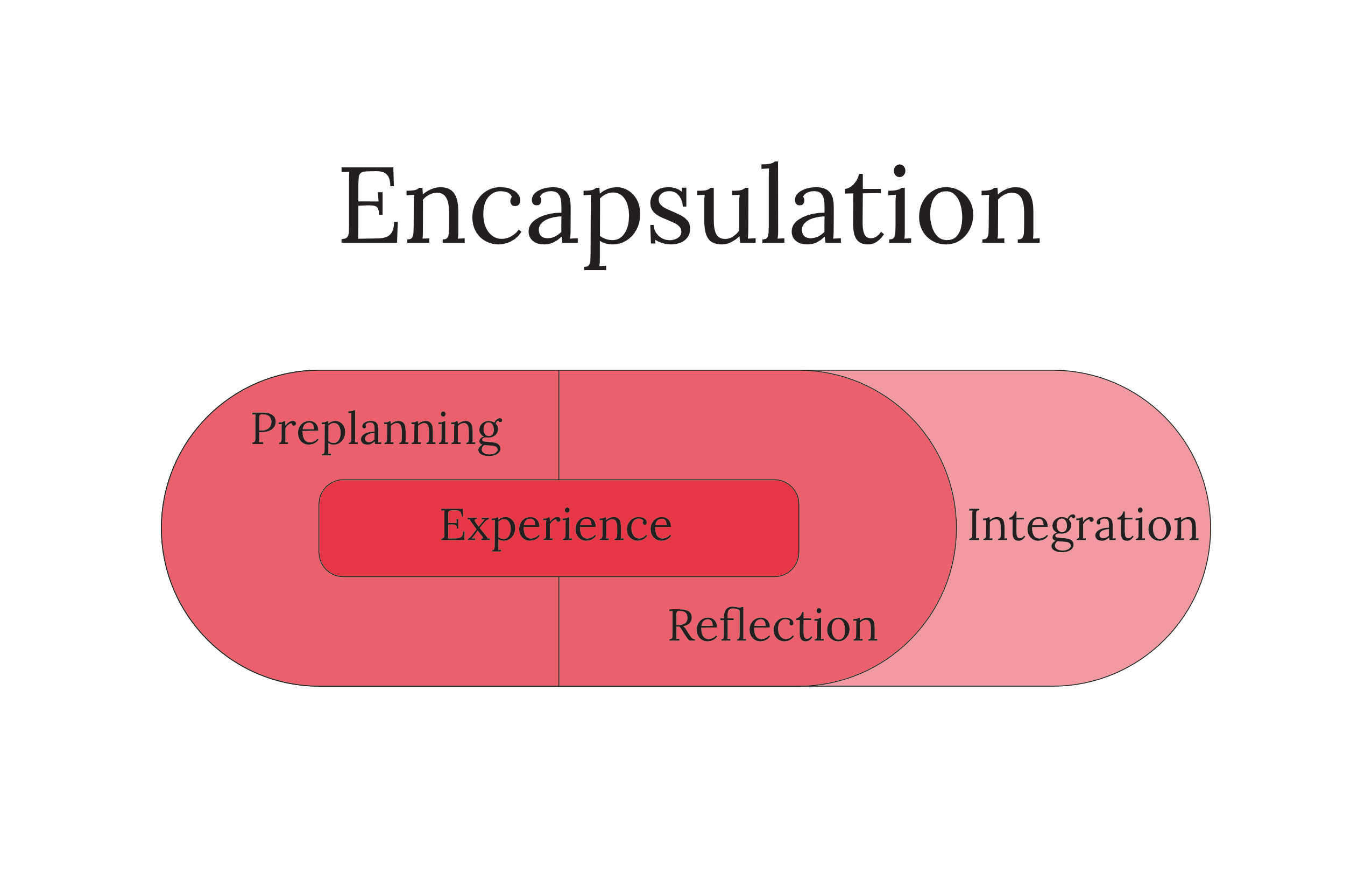
Before the experience, there is preplanning.
Before hiking, you pack your bags for the trip; before a date, you shower, dress up nicely, and pick a nice spot to eat; before an exam, you study and review your study materials.
Pre-planning includes both preparing for the experience and the emotions involved in anticipation. The experience itself may be totally different from what you expect and prepare for. Think of all the times you wanted to go outside and enjoy the fresh air, only to step out and realize it is going to rain soon.
After preplanning comes the experience itself. An experience is measured and valued by one question: How well was my time spent? If you listen to how people talk about attending concerts of their favorite singers or bands, some of them pay ludicrous prices just to hear the music live, yet they still say the time (and money) was well spent. The emotions from the experience trump the cost.
At the end of the experience, there is a reflection. The credits are rolling, and you ask yourself, “Was that a good movie? What did I think about it?” The reflection comes when you have the quiet time to think deeply about what you just experienced.
Now, preplanning and reflection encapsulate the experience, but they are not enough to create a transformation. The transformation comes after there is integration at the identity level. Without it, you have the effect of a temporary transformation before switching back to your original self.
Each experience in isolation may seem insignificant, but when stacked together, they create a compounding effect, changing who you are at the core over time. Given enough time, water turns stone into sand. So too will your experiences shape your behaviors and perspective on life.
So you might already be seeing how this framework can apply to alienated children. This affects them at three different levels.
The Alienator
The first level is the experience curated by the alienator. The alienator wants the child to be unconditionally loyal to them, even at the expense of their relationship with you. In order to achieve that, they stage a series of experiences that lead them to question their ability to determine right from wrong and what is acceptable vs unacceptable.
If you would like to know more about how these experiences are staged, I recommend reading my article, Deconstructing Mind Games, particularly the first section where I talk about the Not My Tempo scene in the movie Whiplash.
After each experience, the child reflects on it and adjusts their behavior. The child is harassed when their behavior goes against the alienator and rewarded when they are compliant.
Over time, the child’s identity has completely changed. Keep in mind, the alienator isn’t degrading the targeted parent 24/7.
In reality, the targeted parents are only mentioned a fraction of the time. The overwhelming amount of harassment the child receives from the alienator is about the child’s behavior. The alienator needs total compliance from the child to feel secure about the child’s loyalty. To attack your credibility, they make it seem to the child that the reason for the punishment is due to the targeted parent.
In preplanning, the alienator has decided that you are not allowed in the child’s life. When the child behaves in a non-compliant way, they attack and harass the child, creating a negative experience. The alienator reflects to see if the child has learned their lesson. If not, they reinforce it repeatedly until the child adopts the new behavior. The child is emotionally and physically exhausted. Compliance is easier and more sustainable than fighting back.
The Targeted Parent
Any time the child interacts with you, whether by text message, phone call, or in-person visitation, you are staging an experience for them.
Now this doesn’t mean you need to behave like a Disneyland parent or an event planner. However, it helps to think about the experience you are creating for the child. The challenge many parents face is that they are so focused on their own experience that they feel they are losing control of everything.
When the child is aggressive or avoidant toward them, they take it as negative criticism of their parenting and as proof of their deepest fear unfolding, triggering their inner insecurities. This leads to a negative experience for both the parent and the child. During reflection, the parent thinks to themself that they are powerless, and in the child’s reflection, the child affirms the accusations about the parent's character that were initially planted by the alienator.
Staging positive experiences is going to be the most important skill for you, the targeted parent. To learn more about this skill, I highly recommend my article, Lighting Paper Lanterns, where you will learn about compounding small positive experiences into larger ones.
Experience doesn’t need to be grandiose or life-changing in a single moment. That kind of thinking puts a lot of pressure on targeted parents, and they will feel crippled with anxiety over sending a text. In my article, “Lighting Paper Lanterns,” I talk about how small yesses can lead to a big yes. A small yes can be as simple as having your child read a text message or have a brief chat about pop culture. Multiple instances of these small experiences give the child time to reflect. That reflection reveals to them that you are not the monster they think you are, and they will start to feel curious.
Keep in mind that age, proximity to the alienator(s), and their ability to care for themselves are major constraints that can limit their ability to reunite with you, so do not assume their silence is an act of malice.
That said, if their curiosity is piqued, they will engage more with you based on the pattern of experiences that you staged for them.
The Alienated Child
The alienated child is facing two opposing sides, and depending on several circumstances like custody agreements, severity of the alienation, the child’s age and sense of autonomy, and the child's personality, they are going to interpret their experiences and behave in a manner that protects their well-being, even at the expense of their identity.
On one hand, the alienator is layering negative experiences and associating them with the targeted parent.
On the other hand, the child is about to visit you after hearing countless horror stories and warnings about your character.
This serves as the child’s preplanning. They are preparing for a battle, steeling themselves for the worst possible outcome. When they are with you, depending on the factors listed above, they will either:
Relax after seeing that you are not dangerous.
Suspect that you are pretending to be nice and will try to test you.
Testing behaviors are a classic mind game: Now I Got You Son of a Bitch. (If you have not read my article, Deconstructing Mind Games, you can learn how mind games work and how to beat them.)
What are they testing for? They want to see if the accusations are true. If you get mad or upset, they think the alienator was telling the truth. If you are non-reactive to their digs, they will likely think you are just good at hiding your ulterior motives.
At face value, it seems like nothing works. However, being non-reactive to their tests puts them in a position to confront whether what they have been told is true at all. And that is a scary place for an alienated child. To realize they have accepted and lived a lie means that they took part in the alienation, which brings out a terrible sense of guilt and shame.
These are the unconscious thoughts swirling in their head during the reflection phase. They don’t quite see how others are shaping their perceptions of their experiences, and they assume the conclusions they draw are their own.
As I mentioned earlier, the more the experience you provide is different from the negative time they expected, the more they question their perception. If the child can say after spending time with you that, “This was time well spent,” they are on the road to reunification, even if they don’t know it consciously yet.
And to reiterate. It is not about one big experience but about the repetition of many small experiences.
“The art and practice of guiding transformations subsumes that of designing and staging experiences. It begins by recognizing that the experiences are not monolithic and can have different levels of engagement that themselves progress upward to successfully offer more value. This extends from merely memorable to highly meaningful, to deeply transporting, and finally to truly transformative.
How You Can Transform Your Alienated Child Back to Their True Self
This is the million-dollar question.
In previous articles, particularly in Finding Love after Alienation Part II, I discussed the need for a good blend of mundane and extraordinary experiences to give the child a sense of normalcy when they spend time with you.
I am not going to repeat those here, but I am going to share a few other tools to help you shape the experience you create for your child when they interact with you. These techniques apply to all severity levels of alienation—you just have to tailor them to your level of communication.
The Pygmalion and Galatea Effect

There is a famous Greek story about the sculptor, Pygmalion (pig-mal-eon).
Pygmalion, devoted to his craft, sculpted his idea of the perfect woman out of stone, naming her Galatea (gal-a-tee-ah). The Goddess of Love, Aphrodite, seeing his devotion to the sculpture, transformed the marble statue into a woman who would marry Pygmalion, and they lived happily ever after.
The Pygmalion effect (also known as the Rosenthal effect) is a psychological phenomenon where higher expectations lead to improved performance in a given area.
The original study was conducted in a classroom setting. Teachers were told that certain students had been identified as “late bloomers” and were expected to perform exceptionally well over the coming year. In reality, those students were selected completely at random. Yet by the end of the year, those students showed significantly greater intellectual gains than their peers.
The teachers never explicitly told the students they were special. But their belief in those children changed how they interacted with them. The teachers were warmer and more patient, offered more challenging material, and provided more feedback to those kids. The children absorbed all of it without realizing it. And they rose to meet the expectations placed on them.
Now think about what this means for you as a targeted parent.
When you tell your child (even an alienated one who is cold, distant, or hostile), “You are kind. You are capable. You are loving. You have always been that way, and nothing will change that for me.”
That is planting a seed of truth. It may not take root immediately. They may roll their eyes or argue with you. But internally, it is much harder to say I am not a loving, kind, smart, strong, and capable person.
Trust is not required for the Pygmalion effect to work.
The mechanism operates below the level of conscious agreement. The child doesn’t have to believe you or like you. They don’t even have to be in the same room with you for very long. What matters is your consistency in communicating to them who they are at their core.
Over time, that becomes part of how they filter their worldview.
If they ever push back and say something self-degrading—I’m not a good person. I don’t care about you. I don’t feel anything—don’t panic, and don’t accept it as their truth.
Simply ask them, with genuine curiosity and no anger behind it: Is that really what you think of yourself?
That question creates a small crack of space between the child and the belief they just stated. Even if they double down, you can step back and ask, “Is that who you want to be?”
If they double down again and say yes, then ask follow-up questions like, “How come?”
Curiosity is the name of the game. No one can logically argue that they want to be a bad or incapable person. Attempting to do so is a clear cry for help, which is where you can step in with love and emotional support.
Worst case scenario, you can end the conversation by saying, “I understand you feel you are not a good person, but I disagree. I have seen the good in you, and I hope in time you can see it too.”
If they reach a point where they are telling you that they want to be a good person, then you can pivot to talking about how you see them as good, kind, capable, smart, funny, and deserving of love.
Now, if the Pygmalion effect is about how others’ expectations shape us, the Galatea effect is how our own self-perception drives our behavior.
Galatea, the statue brought to life, didn’t need anyone to tell her how to be a woman. Once she was transformed, she simply was one. We act in alignment with how we perceive ourselves, often unconsciously, as if fulfilling an unspoken contract with our own identity.
This is why the work of reshaping your child’s self-perception matters so deeply. If they believe—because the alienator has drilled it into them—that they are someone who doesn’t need you, who doesn’t love you, who is better off without you, they will behave in ways that confirm that belief.
When you consistently reflect back to a child that they are loving, that they are kind, that they are someone who cares deeply, even when it is hard to show it, you are slowly rewriting that narrative. And over time, they begin to act from that new self-perception instead.
The inverse is also true, and I watched it play out painfully with a childhood friend.
He had struggled with drug abuse for years, and there were periods where he was genuinely trying to get clean. He was putting in the work, but the people around him kept calling him a drug addict. They would say things like, “You’re an addict. That’s just what you are. You’ll never really change. I bet you were doing drugs earlier.”
What I watched happen over time was pretty sad. He eventually stopped fighting it, and he relapsed. I think he reached a point where he gave up trying to prove them wrong and instead gave them proof that they were right. It was almost like a punishment. He told me one night how, after relapsing, he told his workmates, “Fine. You think I am an addict? Well, maybe I am. Are you happy now?”
This is both the Pygmalion and Galatea effect working negatively. He internalized their perception of him until it became his own, and then he sabotaged himself to prove that perception was true.
This is why I want you to be careful about what you say to your child in moments of anger or frustration.
I understand those moments. The alienation process is designed to provoke you. The testing behaviors, the cruelty, the indifference are a lot of pressure, and the goal, whether the child knows it consciously or not, is to get you to lose control. To say something in anger that confirms every accusation the alienator ever made about you.
But beyond what it does to you in those moments, consider what it does to them.
When you say something in frustration—even once, even if you apologize immediately after—you are contributing to the narrative they are already carrying about themselves. Children in alienation situations are already carrying enormous amounts of shame and confusion about their own identity. Words spoken in anger by the parent they still, somewhere deep down, love and need…those words stick.
Tell your child they are smart, kind, creative, loving, wise, and many other good things, until they believe it.
And for bonus points, tell yourself those same things, too.
Memorialize the Good Times
This is a powerful tip I found in Richard Warshak’s book, Divorce Poison.
When your child is interacting with you, especially if they are spending time with you in person, you want to memorialize the good times.
That means get down on their level and tell them:
“You are a smart kid, and I know you don't forget things easily, right?
Did you have fun today? Yeah, me too.
I want you to know that no matter what happens between me and your mom/dad, that has nothing to do with how much I love you and that never changes.
I know it can feel like a lot sometimes. But look at today. We still figured out how to have fun together.
You're smart, and you have a good memory, right? You probably will remember every detail. So hold onto this memory of today. When things feel confusing or hard, come back to this moment. Remember all the fun moments and I'm always going to be here, and I'm always going to love you.”
What you are doing here is creating an anchor in your child’s mind.
Think back to the encapsulation framework. Every experience has a reflection phase, during which the mind processes what just happened and decides what it means. Most of the time, that reflection happens without you. Your child goes home, and whatever they experienced with you gets filtered through the alienator’s environment, commentary, and version of events.
Memorializing is your way of entering that reflective phase before your child walks out the door.
You are not manipulating them or coaching them on what to think. You are simply drawing their attention to the reality of what just happened between you. You are asking them to hold onto it, to store it somewhere the alienator cannot easily reach.
And children, even deeply alienated ones, have long memories for moments when they felt genuinely loved.
There is something else happening here, too, and it connects directly back to the Pygmalion and Galatea effects. When you say you are a smart kid with a good memory, you are affirming an identity and a sense of responsibility. Smart kids with good memories remember things accurately. They don’t let other people rewrite their experiences.
You are telling them that you trust them to remember the truth.
This only works if it is genuine. Children, especially alienated children, have learned to detect hidden motives, have extraordinary radar for performative speeches, and if this feels like a script, they will sense it. Use the script above as a guide, but change it to fit your situation. Let the spirit of it come through in your own voice.
It also does not need to happen every single visit. In fact, if it happens too often or too mechanically, it will start to feel rehearsed. The most powerful moments are the ones that arise naturally. Something like after you both laugh together at something, that is when you lean in, meet them where they are, and say, “Remember this moment.”
You are building a library of moments that belong to the two of you, that no one can take away.
What Do You Think?
At some point, your child is going to get angry and question you. They might parrot something the alienator said about you and demand answers. As mentioned before, this is a test to see how you respond. A child does not have the capacity to understand why affairs happen, how money can restrict you, or how adults may act imperfectly or even irrationally when pushed over the edge.
There will be times when you may have genuinely made a mistake, and there will be moments when you are accused of doing something heinous that is completely untrue.
Note: I want to make it clear that while I don’t condone affairs, drug abuse, gambling, addictions, alcoholism, and willful neglect of personal responsibilities, I do believe in redemption. If you are committed to transforming your child, you will need to start with the transformation of the self first.
Part of the preplanning an alienator engages in is reminding the child about these accusations. The child is hit with them all at once, and it paints you as this predatory figure who is manipulative and insidious.
The child will ask you, “What about [insert accusation]?”
The natural inclination is known as JADE—Justify, Argue, Defend, Explain. None of those work and they exacerbate the situation.
Instead, calmly pause and ask your child, “What do you think?”
That one question does more work than a ten-minute explanation ever could.
Here is why. The alienator has spent considerable time telling your child what to think. Every accusation, threat, and poisoned story has been handed to the child pre-packaged, with no room for their own reasoning. The child has been a receiver of information, not a participant in it. To the alienator, they are not allowed to have an opinion.
When you ask, “What do you think?” you are treating them like someone whose opinion matters. You are communicating that you are not afraid of the question and, most importantly, you are handing the thinking back to them, which is exactly where it belongs.
Watch what happens in that pause after you ask it. If they are quiet or thinking, do not rush to break the silence. There is great power in sitting comfortably in silence.
The child expected a reaction. They were braced for defensiveness, or anger, or a flood of counter-evidence. What they get instead is a question that puts them in the position of examining what they believe, rather than what they were told to believe. For many alienated children, that is a genuinely novel experience.
Some will double down. They will repeat the accusation louder or insist they already told you what they think. Some will try to deflect by saying you are not answering their question. That is fine. You can follow it with something equally simple, like, “That’s what you were told. But what do you actually think, from everything you’ve seen with your own eyes?”
Avoid saying this as a challenge to their view of the alienator. Just calmly invite them to use their own judgement.
Some will go quiet, which is the sound of genuine reflection. Again, do not rush to fill it and let it sit. You can communicate so much with silence.
Some alienated children will surprise you entirely and actually share what they think. Others may try to BS their way through it. They may express doubt, or confusion, or even defend you. If that happens, resist the urge to leap on it as a victory. Receive it stoically and affirm it by saying, “I appreciate you sharing that. That means a lot to me.”
Now, what about the accusations that are true or partially true?
This is where many targeted parents stumble, because their instinct is to either over-explain due to their feelings of guilt, or to minimize the mistake as a means of self-protection. Neither option serves the child.
If the accusation carries truth in it, the most disarming thing you can do is acknowledge it plainly, without theatrics. “You know what—there’s some truth to that. I did make mistakes. I’m not proud of it, and I understand if that hurt you.”
That’s it. You own it and let it go right there. No pivoting immediately to what the other parent did wrong.
This does something the alienator cannot easily counter. The alienator’s power comes partly from framing you as someone who will never take responsibility. A simple, dignified admission of fault dismantles that framing without a single argument. It also models for the child something they desperately need to see… that an adult can own their mistakes and still be a person of integrity.
And for the accusations that are simply untrue, you do not have to accept them either. But instead of explaining or justifying, just say, “That’s not what happened. And I think somewhere, you already know that.”
Then let it rest.
You are not going to win a courtroom argument with a child in the middle of an alienation situation. But you can leave them with a calm sense of certainty that pushes them to reflect on their experiences with you. Over time, and after a great deal of reflection, the child will start to be curious about you and believe what you are telling them.
Concluding Thoughts
Before I sign off, I want to address a few concerns I have heard from parents:
“Isn’t this being manipulative?”
“I am not a therapist, and I don’t think it is good to use therapy speak with my kids.”
“What’s the point? My kids won’t even talk to me. None of this works if they don’t talk to me.”
All of these are valid concerns, so I want to address them fairly.
Firstly, manipulation involves benefiting from another person's expense. It is not manipulative to teach your child to brush their teeth, eat healthy foods, or go to bed at an appropriate time. Emotional intelligence is a skill that offers many benefits for your child. Telling your child they are intelligent, kind, and loving is not manipulative (this is based on the presumption that you are not lying.) As a parent, your role is to cultivate in your child good values and the strength to take on life’s challenges with anti-fragility. There is nothing manipulative in that. Alienation makes it easy to lose your identity as a parent, so you need to step fully back into your role to reunite.
Secondly, everything I share falls under relationship and communication skills. I do not pretend to know therapy, and I draw many of my insights from proven models used in the business world. This is where you see the most application with minimal restrictions. If it works, why not add that tool to your toolbox? Considering the nefarious means an alienator uses to control your child, you need everything you can find at your disposal.
Even if you were to see a therapist, one of their core goals would be to help you cultivate skills in empathy, relational and self-awareness, communication, and active listening so that you can implement them in your relationships.
Procrastination in this endeavor does you no favors. And even if they do not immediately reunite you with your child, you are opening doors in your life that would not have been possible before.
If the fear of it not working scares you to the point of not trying, then that is a sign that you need to transform yourself first before trying to reunite. You are not a fixed point in time. Anyone can become anything if they truly want it and believe they are capable.
For example, one of my personal heroines would be Betty Ann Waters.

Betty Anne and her brother Kenneth were about as close as siblings could be growing up. However, things took a turn for the worse when her brother was wrongfully convicted of the murder of the elderly woman who lived next door.
Kenneth’s mental health declined in prison, and he attempted suicide. Betty Anne was terrified of losing her brother, and she knew that he was innocent. At that time, she had done everything in her power to obtain legal support to appeal the conviction, but nothing worked, and they did not have the money to hire new lawyers.
Kenneth tells his sister, “If there was anyone who could get me out, you could do it.”
At the time, Betty Anne was a waitress, but she decided she would do whatever it took, no matter how long it required, to get her brother out of prison. Kenneth promised he would never attempt suicide again, knowing that his sister was going to study to become his lawyer.
She went to college and graduated, then she went to law school. After passing the bar exam and becoming a lawyer, Betty Anne located the blood evidence and partnered with the Innocence Project to build a case to exonerate her brother.
After 17 years of wrongful imprisonment, Kenneth Waters was a free man.
Like Betty Anne, you might find yourself in a place where you say that you are not qualified or capable of reaching your kids.
And the hard truth is that your gut instinct is probably right.
But that is good. Because now you can start asking yourself the big questions…
Who do I have to become to reconnect with my kids?
What would the best version of their parent look like?
And how can I be that version of the best possible parent right now?
This article explained how you can transform your alienated child, and, for brevity, I didn’t discuss the transformation of the self. That is just as important, and I strongly encourage you to answer those three questions above for yourself.
Now you have the tools to stage experiences for your child and help transform them. You can also start transforming yourself into the best possible version of yourself.
The only thing left to do is start now.
The power to shape your child’s experiences is in your hands.
Until next time,
Andrew Folkler
Are you a writer on Substack?
If you write about alienation or estrangement, let me know! I would be happy to exchange recommendations to better support our readers.
If you are a general reader who writes about other topics on Substack, please consider recommending Shortening the Red Thread so that other parents can find this newsletter and get the support they need to reunite.
As always, I deeply appreciate your support and am grateful for your feedback as I develop these articles.
I received the message of this post in an email and I have found it to be one of the most helpful readings on help for alienated parents that I have read so far. Andrew is right. One of the hardest parts in dealing with alienation is knowing what to do. I’ve already begun some of what he shared in this writing, but now he has confirmed and clarified what I need to continue doing.
It’s so helpful to know and understand now that I am creating an experience for my children, and when it is good and we laugh, I can help them memorialize it as an anchor. It makes me cry because this is what I needed to know to do. I have felt so lost and alone and devastated by the loss of relationship with my sons. Grieving for living children has been the most painful thing I have EVER experienced in my 45 year lifetime.
It’s also invaluable to be able to know what my kids are experiencing and how it affects them. Now I can see things better from their perspective and I am filled with empathy and compassion for them.
Andrew, thank you for the hope you give us. Thank you for your vulnerability, your strength and your selfless willingness to share your experiences and wisdom with heartbroken but resolved parents like me. I can never thank you enough. I am grateful for you from the bottom of my heart. May God bless you abundantly for what you have been through and are doing now. 💗
Thank you so much Andrew for this thoughtful article. I am the Mum of an adolescent son. His father has been busy alienating me as a parent for nearly 5 years using emotional, psychological and religious abuse. Supporting my son and limiting distress to both myself and my son through this extremely difficult period has been the most difficult part of my life. Your insight into the experiences of parental alienation through the child’s lens had helped me maintain perspective and stamina long term and refuse to give up hope for a strong relationship with my son in future.